When an established textile dyeing cluster in Gujarat received statutory notices in 2023 to meet the Central Pollution Control Board’s (CPCB) Zero Liquid Discharge (ZLD) mandate within nine months—or face plant closure and ₹1 lakh per day penalties—delay was not an option. The ZLD systems they commissioned now recycle over 94% of their process water and avoid more than 72,000 kL of effluent discharge annually, transforming a compliance challenge into a major cost and brand asset. This scenario is playing out across India and the GCC, with water-intensive industries under urgent pressure to deploy ZLD solutions that deliver both regulatory security and real financial returns.
Zero Liquid Discharge Systems: What They Are and How They Work
Zero Liquid Discharge (ZLD) is an advanced wastewater treatment approach whereby any liquid waste generated by a facility—including high-salinity or complex chemical effluent—is processed to extract reusable water, with only a solid residue left for safe disposal. The ZLD goal is that no untreated or even partially treated effluent leaves the site boundary, ensuring complete compliance with evolving regulatory norms such as those by India’s CPCB and various GCC environmental ministries.
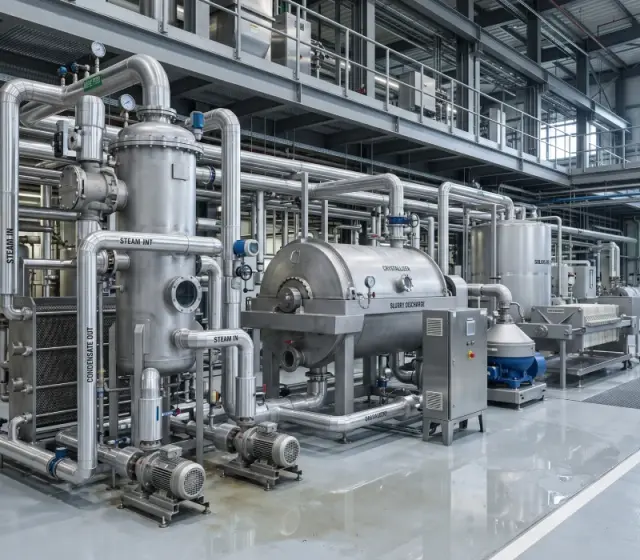
A typical ZLD system integrates technologies such as ultrafiltration, reverse osmosis (RO), multiple-effect evaporation (MEE), crystallization, and sometimes thermal or mechanical vapor recompression (MVR/MVRR):
- Feed capacity: 100–2,000 m3/day for medium-to-large textile, pharma, or chemical plants
- Recovery: 90–98% water reclaimed for process reuse
- Operating pressures: RO: 15–70 bar; evaporators: 0.2–1 bar(abs)
- Footprint: 200–1,400 m2 depending on capacity, integration, and evaporation requirements
Process Overview
- Primary and secondary treatment remove bulk organics and suspended matter
- Advanced treatment (UF/RO) produces high-quality permeate—typically suitable for process/top-up water
- RO reject/brine is concentrated in MEE or MVR/MVRR evaporators
- The final solids (salts, sludge, gypsum) are separated in centrifuges or filter presses for landfill or valorization
Enercon Worldwide engineers ZLD packages with sector-proven technology selection tailored to varying effluent loads, salinity, and site energy costs, ensuring robust, compliant operation even with fluctuating input water quality.
Industrial Sectors: Where ZLD Makes the Biggest Impact
While several process industries generate high-strength wastewater, ZLD delivers the most value and compliance leverage in three key Indian and GCC sectors:
- Textiles: Dyeing and printing units processing 300–2,500 m3/day face CPCB directives for ZLD as a condition for operation renewal. In Tamil Nadu, clusters like Tiruppur have proved ZLD’s ability to recover 95% water and virtually eliminate illegal discharge risks.
- Chemical and Pharma: Units producing APIs, intermediates, or agrochemicals face both byproduct-laden waste streams and unpredictable contaminant spikes. A Hyderabad-based pharma manufacturer with 550 m3/day load saw 92% of its high-cost DM top-up water replaced by RO-permeate from its new ZLD line, while brine is safely landfilled per state PCB guidelines.
- Power and Steel: Large captive power plants and integrated steel mills in water-scarce GCC states (e.g., UAE, Saudi Arabia) are now mandated to minimize groundwater/municipal withdrawals and restrict discharges using ZLD, with several new refineries and steel complexes commissioning 1,500–3,000 m3/day ZLD blocks.
Each sector faces unique regulatory and operational realities that make the choice of ZLD configuration and vendor selection mission-critical.
Tangible Energy and Cost Savings with Modern ZLD Systems
The perception persists that ZLD is simply a compliance cost—yet energy-efficient systems now allow real operating savings through water and chemical recovery, and reduced makeup water demand. For example, a 1,200 m3/day textile ZLD installation in Surat records annual freshwater purchase savings of ₹1.3 crore, and RO-RO Reject based evaporation/recovery cuts their sodium sulfate purchase by 35%.
Efficiency Gains and Operating Benchmarks
- Modern ZLD units with hybrid MEE-MVR can see total process energy requirements as low as 24–38 kWh/m3 (compared to 45–60+ kWh/m3 in legacy setups)
- Automated process control and industry-tailored RO replace 10–18% of fresh DM water makeup with reclaimed stream (for process/cooling in pharma and chemicals)
Enercon Worldwide configures ZLD systems sized for process, with sector-aligned efficiency metrics, driving sustainable water cost optimization rather than only regulatory compliance.
ROI Analysis: Payback Periods and Opex Impact
With rising water procurement costs (₹70–170/kL in most Indian industrial zones, ₹32–60/kL equivalent in GCC) and ongoing risk of regulatory penalties, the ROI narrative for ZLD implementations is increasingly compelling:
- Typical mid-sized textile ZLD capex: ₹6–12 crore (fully installed, 800–1,200 m3/day)
- Operating cost (energy, chemicals, maintenance): ₹120–180/m3 treated
- Freshwater and discharge savings: up to ₹110–135/m3
- Typical payback period: 2.5–4.5 years (textiles, chemicals); in GCC where water tariffs are subsidized but fines are steeper, ROI may be 3–5 years
Worked Example – India
A 1,000 m3/day pharma facility pays ₹95/kL for makeup water and ₹60/m3 for ETP operation/disposal. ZLD saves them ₹1.2 crore/year on water and ₹2.1 crore/year in avoided fines and compliance fees—recovering their ₹9 crore project cost in ~3.2 years, ahead of most boardroom hurdle rates.
Regulatory Drivers: Compliance, ZLD Deadlines, and Risks of Delay
Regulatory escalation is a key ZLD project trigger. In India, CPCB and state PCBs increased ZLD mandates, with Northern states setting 2025 implementation deadlines for textiles and chemicals. Non-compliance exposes operators to:
- Daily penalty of ₹50,000–₹1 lakh for continuing effluent discharge post-deadline
- PAT (Perform, Achieve, Trade) scheme energy efficiency penalties where ZLD integration is required for PAT cycle credits
- Production shutdown/closure notices from SPCBs (as enforced in Ludhiana, Hyderabad, Ahmedabad from 2022–2023)
- ESG and international buyer contract risks—major apparel and pharma buyers now demand verifiable ZLD at supplier sites
Similarly, UAE, Oman, and Saudi Arabia have intensified enforcement of industrial water reuse and ZLD standards. By positioning ZLD investment as a decision accelerator—rather than as a reaction to fines—plant heads not only de-risk but also future-proof compliance and market access.
Operational Challenges and Proven Solutions in ZLD Deployment
While ZLD unlocks undeniable compliance and sustainability value, implementing these systems is not without hurdles. Enercon Worldwide’s project experience highlights several recurring challenges:
- Feedwater Variability: Shifts in salt/organic content can foul RO and reduce evaporator efficiency. Best addressed with tailored pretreatment (e.g., MBR, chemical dosing) and robust process controls.
- Space Constraints: Older facilities struggle to accommodate MEEs and centrifuges. Modular or skid-mounted ZLD packages minimize new civil works and allow phased commissioning.
- Downtime During Retrofit: Production losses during tie-in. Staged implementation—side-by-side ETP and ZLD pilot testing—can maintain operational continuity.
- O&M Complexity: Skilled operators needed for multi-stage process. Integrating MBR/RO with SCADA-based automation simplifies routine management and enables remote monitoring, which Enercon includes in all modern deployments.
How Modern ZLD Systems Outperform Outdated Approaches
Compared to legacy ETPs with partial recovery, advanced ZLD solutions transform both economics and risk profile. Key differences include:
- Water Recovery: ETPs typically recover 50–60% under best conditions; modern ZLD achieves 90–98% water closure.
- Salt/By-product Handling: Partial treatment leaves high-salinity reject for tanker disposal—now illegal and audit-prone. ZLD produces dry, landfill-ready salts or, where feasible, valorized gypsum/sulfate by-products.
- Energy Costs: New MEEs and MVR retrofits powered with waste steam or solar reduce net opex by 18–25% compared to standalone electric heating.
For plants evaluating ZLD vs. ETP upgrades, sector-tailored ZLD is now the only practical option to ensure both permit renewal and long-term resilience against tightening NPAs and ESG audit standards.
Industry Case Studies: Textile and Chemicals Lead the Way
Textile Cluster – Tamil Nadu
A dyeing house in the Tiruppur cluster faced closure unless it shifted 950 m3/day effluent load to ZLD. With Enercon Worldwide as EPC partner, the engineered system—featuring staged UF-RO and twin-effect evaporation—reclaims 97% water for reuse and produces 32 tonnes/week of saleable sodium sulfate. Their annual savings: ₹1.1 crore on water, ₹41 lakh on brine disposal, and zero compliance fines.
Agro-Chemicals – Gujarat
An agrochemical manufacturer discharged 410 m3/day high-TDS effluent. After enforcement of revised GPCB standards, ZLD was engineered (MBR pre-treatment, RO, single MEE, salt centrifuge). Now, 94% of water is recycled, 9.2 tonnes per day of salts are safely landfilled, and the plant earned ₹68 lakh PAT scheme credits in the latest audit cycle.
These sector-driven case studies prove that ZLD, when correctly specified and implemented, delivers measurable ROI alongside peace-of-mind compliance—especially with engineering support from a partner like Enercon Worldwide.
Emerging Trends in ZLD: Smarter, Greener, More Integrated
- Digitalization & Industry 4.0: AI-driven SCADA and real-time analytics enable predictive maintenance, optimize membrane cleaning, and automate setpoints for varying feedwater profiles.
- Hybrid Energy Integration: Solar process heat and waste steam co-utilization can reduce thermal ZLD energy consumption by up to 30% in large sites, paying back solar field investments in ~4 years.
- Material Circularity: Value recovery from ZLD by-products—such as gypsum for cement or sodium sulfate for textiles—turns regulatory cost into new revenue streams.
- Modular ZLD Skids: Plug-and-play modules, pre-tested for 200–500 m3/day flows, shrink site installation to as little as 8 weeks.
Enercon Worldwide actively incorporates these innovations, offering smart ZLD plants ready for evolving regulatory and market demands.
Choosing the Right ZLD System: Key Criteria and Red Flags
Checklist for Industrial Buyers
- Proven performance in your process sector (ask for installations treating your specific wastewater composition)
- Energy cost per m3 of treated water (target ≤38 kWh/m3 for new systems)
- Scalability and ease of integration with existing ETP/utility footprint
- Automation and remote O&M support—can the plant be managed efficiently by existing staff?
- Clear track record of CPCB/state PCB or GCC regulatory approvals
Warning Signs
- Vendors with little or no reference plants in India or GCC for your industry
- Systems promising 99%+ recovery with no process data—overclaims here result in downtime and unplanned cost
- Opex calculations that ignore energy, brine disposal, or membrane replacement costs
- Lack of digital or automation integration for long-term reliability
Enercon Worldwide recommends a full site technical audit and pilot-scale testing as the critical first step for de-risked and bankable ZLD adoption.
The Next Step: Act Before Deadlines Cut Off Options
ZLD is no longer a future aspiration for water-intensive manufacturing. CPCB’s and state PCBs’ April 2025 deadlines are now under a year away for many operational plants, and typical ZLD project timelines—from feasibility, detailed engineering, permitting, procurement, to commissioning—run 9–14 months. For Indian and GCC industries facing mounting enforcement and rising water tariffs, the strategic window for risk-free ZLD implementation is closing fast.
The ideal path is to initiate a technical feasibility study and process audit within the next quarter, ensuring no surprises threaten plant operation or supply chain access. With proven experience across textile, pharma, chemicals, and steel, Enercon Worldwide stands ready as a knowledgeable engineering partner—capable of scoping the right ZLD solution, overseeing compliance, and ensuring that your project delivers both regulatory certainty and real operational ROI. Don’t let avoidable delays limit your options—make ZLD readiness your next boardroom priority.
Related Enercon solutions
Planning an energy or utility project? Talk to the engineers at Enercon Worldwide or request a consultation. You can also browse all our business areas.