A leading textile exporter in Gujarat was hit with a ₹1.2 crore CPCB fine and a two-week plant shutdown after failing to meet the ZLD (Zero Liquid Discharge) norms introduced in 2022. This scenario is increasingly common across India and the GCC as regulators mandate total wastewater recycle. Today, ZLD systems are not just “green investments” but a strategic imperative to maintain production, protect margins, and avoid escalating non-compliance costs.
What is Zero Liquid Discharge? Core Technology Explained
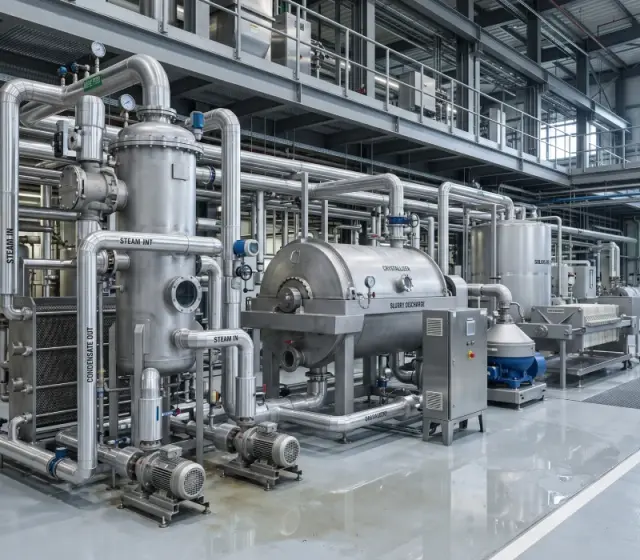
Zero Liquid Discharge (ZLD) is an advanced wastewater treatment process designed to eliminate liquid waste discharge from industrial operations. The objective: recover and recycle nearly all water, leaving behind only solid waste. ZLD systems typically integrate primary, secondary, and tertiary treatment steps—ending with technologies such as Multi-Effect Evaporators (MEE), Reverse Osmosis (RO), and crystallizers.
Engineering Specifications:
- Typical plant capacities: 100 m³/day (small pharma/textile) to 5000+ m³/day (large refineries, power plants)
- Feeds: High TDS effluent (2,000–60,000+ ppm); COD from 500 to 10,000+ mg/L
- Temperatures: RO at ambient, evaporators at 65–110°C
- Water recovery rates: 90–98%
Result: Treated water is recycled to process or utilities, and solidified salts/sludge are landfilled or reprocessed.
Key Industrial Sectors and Real ZLD Use Cases
Textile & Dyeing Units: The CPCB and GPCB have rendered ZLD non-negotiable for medium- and large-scale textile plants. For a Surat dyeing unit discharging 1,200 m³/day with high-color, high-TDS effluent, ZLD deployment enabled 92% water recycle, cutting their freshwater bill by ₹1.4 crore/year and shielding them from regulatory closure threats.
Pharmaceutical Manufacturing: Pharma effluent is loaded with organics and complex chemicals. A Hyderabad API manufacturer implemented ZLD (capacity 600 m³/day), using advanced RO-MEE integration. This not only reduced fresh water intake but ensured compliance with Pollution Control Board zero-discharge mandates, gaining ESG points for exports.
Power & Chemical Plants: Large utilities, refineries, and fertilizer plants—especially in water-stressed GCC and Rajasthan—often face withdrawal caps. An Abu Dhabi refinery implemented ZLD for 3,500 m³/day, recycling 95% of process water and achieving payback in under 3.5 years through avoided water purchase and discharge fees.
Inside a Modern ZLD System: Process Flow Breakdown
Modern ZLD systems are tailored to industry and effluent complexity, but most configurations involve:
- Pre-Treatment: Removes suspended solids (clarifiers, filters), organics (biological/EQ tanks)
- RO & Ultra-filtration: High-efficiency membranes separate 70–85% of clean water
- Evaporation: Multi-effect evaporators concentrate RO rejects; use indirect steam at 0.6–2.5 bar, energy-efficient design
- Crystallization: Final drying and solidification of brine; salts often XRD-characterized for landfill approval
Innovations include MVR (Mechanical Vapor Recompression) evaporators (energy savings of 10–20%) and spray dryers for low-footprint installations.
Energy Efficiency Insights: How Modern ZLD Cuts OPEX
Energy consumption is the largest OPEX factor in ZLD. Traditional single-effect evaporators can demand 1.3–1.7 kWh per liter of water evaporated, seriously impacting utility bills. By contrast, modern multi-effect or MVR-based ZLD systems operate at 0.7–1.1 kWh/liter, a 35–45% reduction. Integration with plant waste steam (cogeneration) further slashes energy spend. Enercon Worldwide has achieved net thermal savings of 8–15% on plants retrofitting advanced evaporators compared to legacy ZLD setups.
In textile ZLD retrofits, total energy used for water recovery has been reduced from 1,150 kWh per 1000 m³ to under 700 kWh—a measurable impact on EBITDA for water-intensive operations.
Cost Optimization and Real-World Payback Analysis
Is ZLD just a compliance cost, or does it pay for itself? In most Indian and GCC use cases, the math justifies the investment. Consider a 1,000 m³/day ZLD unit for a textile plant:
- Capex: ₹13–18 crore installed (India)
- Annual OPEX (power, chemicals, maintenance): ₹1.2–2 crore
- Fresh water savings (₹70/kl x 330,000 kl/year): ₹2.3 crore
- Effluent disposal savings & avoided penalties: ₹1.1 crore
- Total annual benefit: ~₹3.4 crore
- Typical payback: 4.2–5.5 years (textile/pharma), 3–4 years (GCC, power/chemical with higher tariffs and water scarcity)
Factoring in PAT scheme energy incentives, and GST refunds on ZLD investments, paybacks may shorten by up to 8 months.
Sustainability, Compliance, and Regulatory Drivers
CPCB & SPCB Norms: As of 2022, the CPCB mandates ZLD for all large-scale textile, pharma, and tannery units in Ganga basin and Tier 1 states. Violation triggers closure and fines up to ₹5 crore/month.
PAT Scheme: Units under the Perform Achieve Trade (PAT) cycle can claim ESCerts for demonstrating water and energy savings via ZLD integration.
GCC Directives: Saudi Arabia and UAE environmental authorities (MEWA, EAD) have moved towards ZLD for power and petrochemical sectors, with penalties for non-compliance and incentives for water conservation.
ZLD systems also act as a proactive ESG measure: for a food processor in Karnal, deploying ZLD contributed to a 76,500 kl/year water saving and an 800 tCO2/year emissions reduction (from reduced water transport and treatment), enhancing global brand credentials.
The Steep Cost of Inaction: Non-Compliance and Business Risk
Ignoring ZLD is no longer a “cost deferment”—it is an operational risk. Plants facing surprise audits are seeing not just regulatory fines, but full plant closures until compliance evidences are filed. For a leading dye house in Ludhiana, a 21-day shutdown after ZLD bypass meant >₹5 crore revenue loss, plus long-term customer contract penalties.
- CPCB and CAQM: Fast-emerging “name and shame” orders and blacklistings mean higher insurance premiums and investment risk for non-compliant plants.
- Production Loss Impact: Downtime from non-compliance is often 5–20x costlier than ZLD OPEX.
- ESG and Audit Failures: Failure to achieve ZLD-compliant status can block access to key global buyers, especially in pharma and textiles exporting to EU and US markets.
Operational Challenges in ZLD: What Plants Must Plan For
Despite high-value promise, ZLD implementation presents real-world engineering hurdles. Key pain points include:
- High TDS Variability: Sudden effluent chemistry shifts can foul membranes or evaporators; dynamic process monitoring is essential.
- Space Constraints: ZLD systems require 200–800 m² minimum; modular designs, as supplied by Enercon Worldwide, help fit into brownfield sites.
- Downtime During Retrofit: Average ZLD upgrades need 2–6 weeks of integration—requiring careful scheduling to avoid peak production loss.
- Manpower Skill Gap: Regular operator training is necessary for membrane/evaporator management; automation helps but does not fully replace skilled staff.
Enercon collaborates on operator training and digital monitoring to mitigate these risks, shortening the learning curve and reducing trial-and-error downtime.
ZLD Technology Comparison: Modern Systems vs. Conventional Approaches
Not all ZLD solutions are made equal. Plants must distinguish between:
- Legacy Evaporator-Only Systems: Higher energy cost (1.4–1.7 kWh/liter), poorer water recovery (<75%), less fit for high-efficiency or high-water-cost regions.
- Modern Hybrid ZLD: Advanced RO + MEE/MVR + crystallizer; 90–98% water recovery and up to 35% lower OPEX.
- Zero-Discharge by Pass: Outdated “pond storage” or periodic discharge, increasingly banned and heavily penalised by regulators.
For high-COD or multi-stream plants, only hybrid modern ZLD solutions can ensure full compliance and cost control, especially where water purchasing costs exceed ₹50/kl (common in Western India and GCC).
Sector Spotlights: Deep Dive on Textile, Pharma, and Power
Textile: Brownfield ZLD Retrofit
A 1,800 m³/day dyeing plant in Tirupur faced plant closure due to SPCB’s show-cause notice. Enercon Worldwide’s containerized ZLD (RO+MEE, fully automated) brought recycling up to 94.7% and cut annual freshwater procurement by 370,000 kl. Payback, factoring in compliance fine avoidance, achieved in 4.3 years.
Pharma: High-TDS, High-TOC Waste
An API plant in Hyderabad migrated from a simple ETP to a full ZLD system, overcoming persistent compliance failures. With advanced organics destruction and two-stage RO, 95%+ water recovery was achieved, eliminating annual ₹1.4 crore in pollution control penalties and facilitating $5M worth of new export contracts due to enhanced ESG compliance.
Power: GCC Refinery Installing ZLD
A Saudi Arabia power plant upgraded to ZLD to meet MEWA’s strict discharge norms. Multiple-effect vapor recompression evaporators integrated with plant waste steam reduced ZLD energy use by 22%, while water purchase costs dropped by SAR 1.9 million/year. Complete ROI: 2.9 years.
Future Trends: Toward Smarter, Greener ZLD
- AI-Integrated Predictive Controls: Machine learning to optimize dosing, fouling detection, and energy use (already piloted at scale by Enercon partners in GCC chemicals)
- Low-Temperature Evaporation: Emerging technologies driving down steam requirements, enabling solar-thermal/ZLD hybridization
- Chemical Recovery & Circular Economy: New ZLD modules for caustic soda or dye salt reuse can offset OPEX by up to 20% in specific industries
- Modular and Containerized ZLD: Pre-fab units for rapid deployment and compliance—enabling turnaround times of 8–14 weeks versus 6–8 months for traditional builds
Making the ZLD Decision: A Checklist for Plant Managers
Key Evaluation Criteria
- Does your state/sector mandate ZLD? (Textile/Pharma—most likely yes in India)
- What is your typical effluent flow and TDS/COD load?
- Current water sourcing costs, restrictions, and long-term risk?
- Available footprint for ZLD system?
- Technology vendor O&M track record and 3–5 year OPEX guarantees?
Vendor Selection: Questions to Ask
- Can the provider show reference sites with comparable effluent?
- Does the ZLD integrate with energy recovery or renewable steam sources?
- What digital monitoring options are offered for compliance evidence and alerts?
If you can’t answer “yes” to two or more above, an energy and water audit with an experienced partner such as Enercon Worldwide is the logical next step before specification.
Prepare for the ZLD Mandate Now
Plants in India aiming for CPCB and PAT compliance in the FY26 cycle must commission ZLD retrofits at least 12–16 months prior to the mandatory reporting deadline—leaving little time for assessment, tendering, and build-out. In the GCC, rising water costs and penalties mean every quarter of delay in ZLD implementation can add 5–8% to both OPEX and compliance risk.
Ultimately, the logic for ZLD has become business-critical rather than optional. The right system leverages operational savings, secures compliance, and positions your plant for future ESG success in global markets. Start with a rigorous water and energy audit—Enercon Worldwide supports every phase, from feasibility to commissioning, tailored to your sector and site needs.
Related Enercon solutions
Planning an energy or utility project? Talk to the engineers at Enercon Worldwide or request a consultation. You can also browse all our business areas.