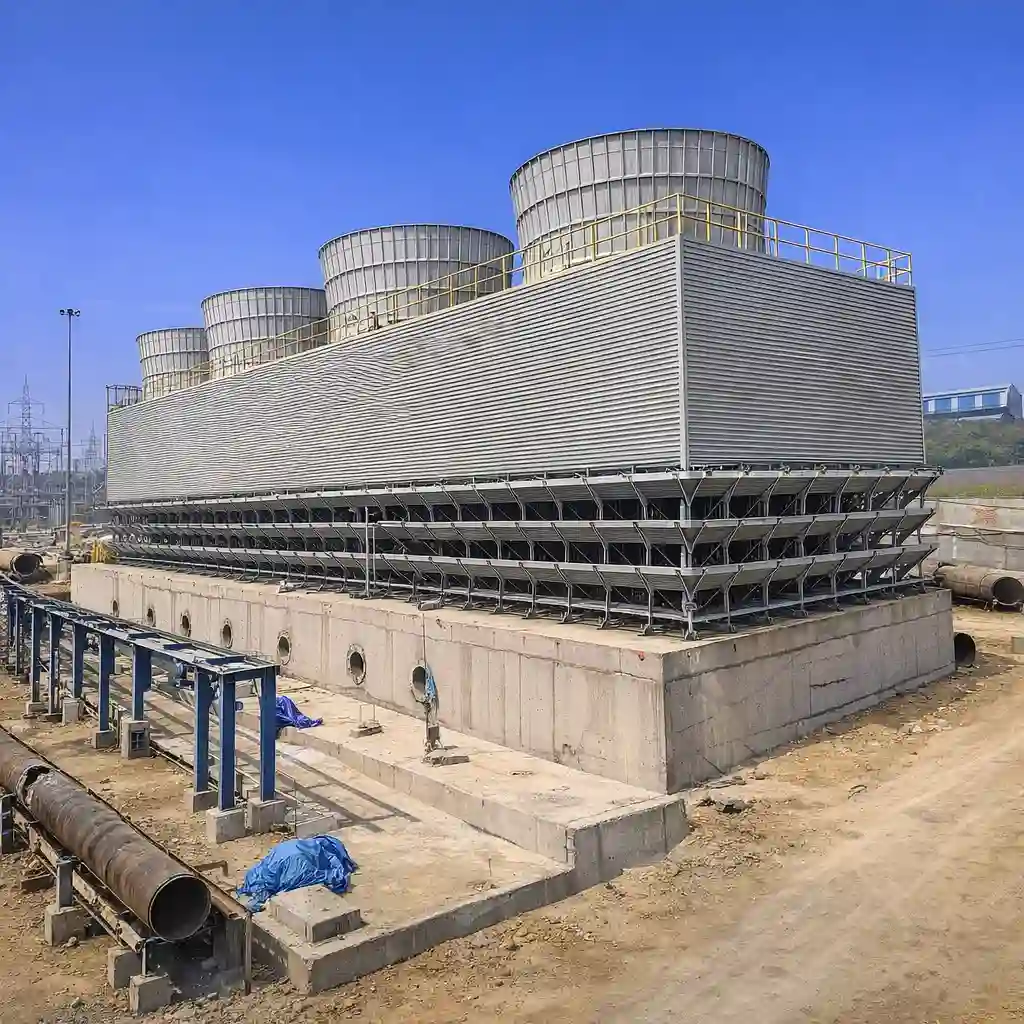
A cooling tower can reject the required process heat while still wasting substantial amounts of water and electricity. In many factories, the root cause is not the tower itself but poor control of cycles of concentration, excessive blowdown, unstable water chemistry, fouled heat exchangers, or fans and pumps operating without reference to actual cooling demand. Industrial cooling tower water optimization addresses these connected losses as one operating problem.
This subject is especially important for chemical plants, food and beverage facilities, steel plants, refineries, textile units, and other continuous-process operations. A small increase in circulating-water concentration may reduce makeup water, but an aggressive approach can increase scaling and corrosion. Similarly, reducing fan speed saves electricity only when the condenser or process cooler can still achieve its required outlet temperature. The practical objective is controlled optimization, not simply minimum water use.
Why cooling tower performance deteriorates even when the equipment is running
A cooling tower system normally includes the tower, circulating-water pumps, heat exchangers or condensers, makeup-water equipment, blowdown valves, chemical dosing, drift eliminators, fans, and controls. Performance depends on the combined behavior of these components.
Common operating symptoms include high makeup-water consumption, frequent manual blowdown, rising conductivity, visible deposits on fill or heat-transfer surfaces, biological growth, unstable cold-water temperature, excessive fan vibration, and pumps running at full speed during low production periods. These symptoms are often treated separately. In reality, they may arise from one unbalanced water and heat-rejection system.
For example, a tower operator may increase blowdown whenever conductivity rises. This protects against excessive dissolved solids, but it also sends heated, chemically treated water to drain and increases the volume of makeup water that must be conditioned. If the makeup water has high hardness or silica, the replacement water can introduce the same scaling tendency that the blowdown was intended to control. The solution requires measurement and water chemistry management rather than a permanently open blowdown valve.
The operating variables that matter most
Cycles of concentration describe how much dissolved material is concentrated in circulating water compared with the makeup water. A simplified relationship is:
Cycles of concentration = circulating-water dissolved-solids concentration divided by makeup-water dissolved-solids concentration.
As cycles increase, the volume of blowdown required for a given evaporation rate generally decreases. However, the allowable value depends on hardness, alkalinity, silica, chloride, sulfate, temperature, metallurgy, treatment chemistry, and the limits of connected heat exchangers. There is no universal cycles-of-concentration target suitable for every plant.
Evaporation loss is the water that leaves the tower as vapor during heat rejection. It is primarily related to the heat load and the range between hot-water inlet and cold-water outlet temperatures. Drift loss consists of small liquid droplets carried out with the exhaust air. Modern drift eliminators can limit this loss when correctly selected, installed, and maintained. Blowdown loss is the deliberate discharge used to control dissolved solids. Leakage and overflow are avoidable losses caused by damaged basins, faulty level controls, valve passing, or poor maintenance.
These losses should be measured separately where possible. A site that attributes all makeup water to evaporation may overlook a passing automatic valve or an overflowing basin. A reliable water balance begins with makeup-water flow, blowdown flow, operating hours, basin level, and production-linked heat load.
How industrial cooling tower water optimization works in practice
The first step is to establish a baseline under representative operating conditions. Record makeup flow, blowdown flow, circulating-water conductivity, pH, temperature at tower inlet and outlet, wet-bulb temperature, pump status, fan speed, and the operating status of major process users. Measurements should cover high-load, low-load, startup, shutdown, and seasonal conditions rather than a single shift.
A conductivity controller can then regulate a blowdown valve more consistently than manual operation. The controller should be connected to a properly selected sensor, with an alarm for sensor failure and a defined response to loss of instrument signal. Conductivity alone is not enough if the limiting contaminant is silica, calcium hardness, chloride, or a corrosion-related parameter. Periodic laboratory testing is still necessary to verify that the control point represents the actual water chemistry risk.
Makeup-water control should also be reviewed. A modulating makeup valve, reliable level transmitter, high-level alarm, and low-level protection can prevent unnecessary overflow while protecting pumps from cavitation. Where water quality varies significantly, the treatment program should be linked to source-water analysis rather than adjusted only after deposits appear.
On the energy side, variable-frequency drives can allow fans and pumps to respond to actual tower approach temperature, process return temperature, or system pressure. The control sequence must include minimum flow requirements, motor protection, freeze or low-temperature logic where relevant, and safeguards for heat-sensitive production equipment. Lower speed is not automatically better if it causes poor distribution across the fill or insufficient flow through a process heat exchanger.
Why water chemistry and heat transfer must be managed together
Cooling tower chemistry is an engineering constraint on heat-transfer performance. Scale on a heat-exchanger surface adds thermal resistance, increasing the temperature difference required to remove the same process heat. Operators may respond by increasing fan speed, lowering process throughput, or running additional pumps. The resulting energy and production penalties can exceed the cost of the original water-treatment problem.
Corrosion creates a different risk. It can damage carbon-steel piping, heat exchangers, basins, and pump components, while corrosion products can foul strainers and narrow passages. Microbiological activity can contribute to deposits, odor, under-deposit corrosion, and health-related management concerns. Treatment programs therefore need coordinated control of scale, corrosion, and biological growth.
The correct program depends on the makeup-water characteristics and the materials in the circuit. A chemical supplier or water-treatment engineer may recommend dispersants, corrosion inhibitors, biocides, pH adjustment, filtration, or pretreatment. The plant should evaluate the total operating cost, including chemicals, monitoring, wastewater handling, maintenance, and downtime. A low chemical price is not evidence of a low-cost cooling-water program if the treatment causes unstable operation.
Side-stream filtration can be useful where suspended solids, corrosion products, or airborne dust are continuously entering the basin. It does not replace blowdown control or chemical treatment, but it can reduce the solids burden circulating through the system. The filtration rate, backwash arrangement, pressure drop, and maintenance access should be checked before installation.
An illustrative water and energy calculation
Illustrative example: consider a cooling tower system operating 6,000 hours per year with an average evaporation loss of 20 cubic metres per hour. Assume the existing system operates at three cycles of concentration and has a combined drift and leakage allowance of 1 cubic metre per hour. A simplified relationship for blowdown is evaporation divided by cycles minus one. Under these assumptions, blowdown is approximately 10 cubic metres per hour, and total makeup is approximately 31 cubic metres per hour.
If stable treatment and instrumentation allow operation at five cycles of concentration without exceeding the plant's chemistry limits, the simplified blowdown becomes approximately 5 cubic metres per hour. The potential makeup-water reduction is therefore approximately 5 cubic metres per hour, or 30,000 cubic metres per year at the assumed operating schedule. This is an illustrative calculation, not a guaranteed result. Actual water savings depend on evaporation, drift, leaks, blowdown control accuracy, water chemistry, weather, process load, and operating hours.
There may also be an energy effect. Suppose a 45 kilowatt pump operates continuously but can be reduced to an average of 36 kilowatts through variable-speed control during lower cooling demand. The illustrative electrical reduction is 9 kilowatts multiplied by 6,000 hours, or 54,000 kilowatt-hours per year. At an assumed electricity cost of 10 currency units per kilowatt-hour, the associated annual value would be 540,000 currency units before considering demand charges, maintenance, controls, and capital cost.
This calculation should not be used as a project approval figure. A feasibility study should use measured flow, pressure, motor loading, tariff structure, cooling demand, and the required process-temperature limits. It should also account for the cost of sensors, automation, drives, chemical-treatment changes, filtration, installation, and commissioning.
Where industrial cooling tower water optimization delivers the greatest value
Continuous-process chemical and refinery units often benefit from improved control because cooling demand remains high and heat exchangers are sensitive to fouling. In these plants, a small change in cooling-water temperature or flow can affect process stability. Optimization should therefore be tied to process constraints rather than a tower-only target.
Food and beverage plants may have multiple cooling users operating on different schedules, including refrigeration condensers, compressors, pasteurization utilities, and process chillers. A common header can experience large load variation. Sequencing pumps and fans according to active demand may reduce energy consumption, but hygiene, water quality, and maintenance access remain important considerations.
Steel and metal-processing facilities may operate cooling circuits exposed to dust, high heat flux, and intermittent loads. Side-stream filtration, robust instrumentation, and protection against sudden temperature changes may be more valuable than simply increasing cycles of concentration. Water availability and the reliability of makeup treatment should be assessed before tightening blowdown control.
Textile plants can have variable production schedules and several cooling consumers, such as compressors, chillers, and process auxiliaries. Their optimization opportunity may lie in eliminating overflow during low-load periods, correcting poorly balanced distribution, and matching pump operation to the actual number of users. The solution should be based on a water and energy profile rather than on tower nameplate capacity.
Retrofit challenges that can undermine the business case
Existing cooling towers are rarely isolated packages. A retrofit may involve electrical panels, motor control centers, process interlocks, water-treatment dosing, instrumentation, plant networks, and discharge arrangements. The physical location of sensors matters. A conductivity probe installed in a stagnant section may provide a misleading value, while a temperature sensor placed too close to a mixing point may not represent the process condition.
Fan control also requires care. Variable-frequency drives can improve part-load operation, but the motor, gearbox, fan, vibration limits, minimum speed, and harmonic effects must be checked. Pump throttling may reduce flow but waste pressure energy; a correctly engineered speed-control strategy can be more effective, although it requires confirmation that the pump remains within an acceptable operating range.
Water-treatment changes can expose hidden weaknesses. Raising cycles without reviewing concentration of silica, chloride, hardness, and suspended solids may create deposits or corrosion. The plant should define alarm limits, sampling frequency, chemical dosing response, and a fallback operating mode before changing the setpoint.
Maintenance access is another practical issue. Drift eliminators, fill, nozzles, strainers, conductivity probes, valves, and level instruments must be inspectable and cleanable. A control system that cannot be calibrated during planned maintenance will gradually lose credibility with operators.
A decision checklist for plant managers and EPC teams
Before approving an industrial cooling tower water optimization project, the project team should answer several questions:
- What are the measured makeup, blowdown, evaporation, drift, and leakage quantities?
- Which water-quality parameter limits the operating cycles: hardness, alkalinity, silica, chloride, conductivity, or another factor?
- What are the minimum and maximum cooling loads across production schedules and seasons?
- Which process users require a specific outlet temperature, flow, or pressure?
- Are the existing flowmeters, conductivity sensors, temperature sensors, and level instruments accurate and maintainable?
- Can the electrical system accept variable-frequency drives and the associated control changes?
- What happens if an instrument fails or communication with the supervisory control system is lost?
- Will the proposed water-treatment program increase chemical consumption, wastewater load, or operator workload?
- Can the project be installed during a planned shutdown, and what temporary cooling arrangement is required?
- How will savings be verified after commissioning?
The supplier or engineering partner should provide a control narrative, instrument list, water balance, operating limits, maintenance requirements, and commissioning plan. A proposal that promises water savings without defining chemistry limits and measurement methods is incomplete.
Digital monitoring and the next stage of optimization
Over the next several years, cooling-water systems are likely to use more connected measurement rather than relying on periodic manual readings. Online flow, conductivity, temperature, pressure, vibration, and power data can be integrated into SCADA or an energy-management platform. Trend analysis can identify gradual fouling, abnormal makeup consumption, valve passing, or fan degradation before the problem becomes a production event.
Advanced analytics can compare cooling performance against wet-bulb temperature and process load, helping operators distinguish weather effects from equipment deterioration. Predictive maintenance can support inspection planning for pumps, fan gearboxes, motors, and drift eliminators. These tools are useful only when the underlying instruments are calibrated and the data is linked to meaningful operating decisions.
Enercon Worldwide can contribute to this type of project through its broader capabilities in industrial energy plants, utility optimization, industrial cooling systems, and process optimization. The engineering focus should remain on integrating water, heat rejection, electrical consumption, controls, and production requirements into one practical design.
Make the next decision from measured plant data
Industrial cooling tower water optimization is not a single equipment purchase. It is a controlled operating strategy built around a verified water balance, stable chemistry, correct heat-transfer performance, and demand-based operation of fans and pumps. The most attractive project may combine several modest interventions: repairing overflow, automating blowdown, improving filtration, correcting distribution, and reducing part-load motor speed.
The appropriate next step is a site assessment covering at least one representative production cycle and, where possible, different seasonal conditions. Record water flows, temperatures, conductivity, pressure, motor loading, fan speed, process demand, and maintenance history. Use this information to establish a baseline, identify the limiting parameter, and calculate savings with plant-specific assumptions.
Enercon Worldwide can evaluate cooling and utility requirements as part of an integrated engineering review. For the plant owner, the key approval question is not whether the tower can use less water in theory. It is whether the proposed controls and equipment can reduce water and energy consumption while preserving heat-rejection capacity, water quality, maintenance access, and production reliability.
Related Enercon solutions
Planning an energy or utility project? Talk to the engineers at Enercon Worldwide or request a consultation. You can also browse all our business areas.