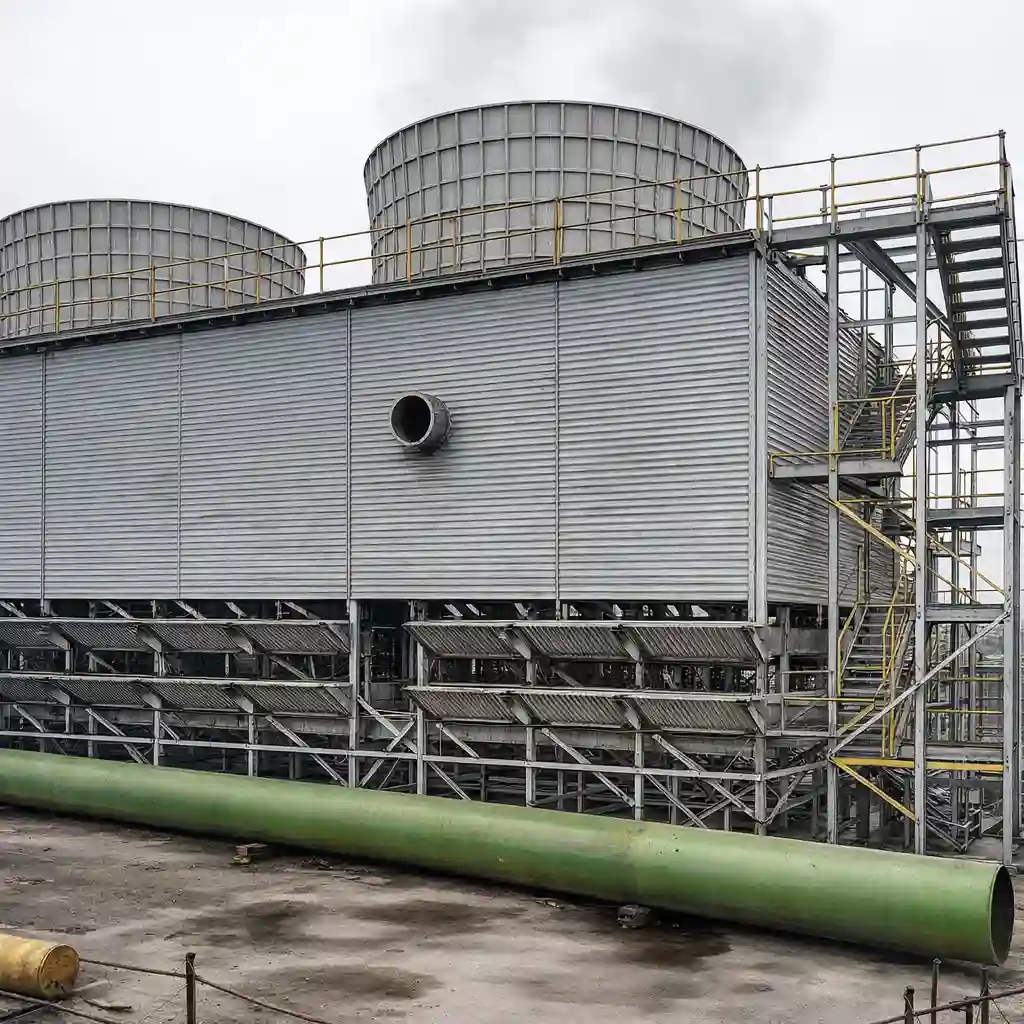
A cooling tower can circulate the same water repeatedly, but it cannot evaporate dissolved minerals. As water leaves the tower as vapor, salts remain behind and become increasingly concentrated. If the concentration rises too far, scale, corrosion, biological growth, and blocked heat-transfer surfaces can cost more than the water saved. If it is kept unnecessarily low, the plant spends more on makeup water, chemicals, pumping, and wastewater discharge.
This is the engineering decision behind cooling tower cycles of concentration. The objective is not simply to operate at the highest possible cycle number. It is to identify the highest stable concentration that the tower, heat exchangers, water chemistry, treatment system, and operating team can support. That requires a water balance, reliable conductivity measurement, disciplined blowdown control, and an understanding of where the plant can tolerate risk.
What cooling tower cycles of concentration actually mean
Cycles of concentration, often abbreviated as COC, describe how much more concentrated the circulating cooling water is than the incoming makeup water. In a simplified calculation, the cycle value can be estimated by comparing a conservative dissolved constituent in the circulating water with the same constituent in makeup water.
For example, if the chloride concentration in circulating water is approximately four times the chloride concentration in makeup water, the system is operating at roughly four cycles on that indicator. Conductivity is commonly used for automatic control because it responds to the total ionic content of the water and can be measured continuously. However, conductivity is not a complete substitute for laboratory analysis. Different ions affect conductivity differently, and the most limiting constituent may be silica, calcium hardness, alkalinity, chloride, sulfate, iron, or another contaminant.
The water balance is also important. In a basic open recirculating system, water leaves through evaporation, drift, and blowdown. Makeup water replaces all three losses. Blowdown is the controlled discharge used to prevent dissolved solids from reaching unacceptable levels.
A simplified relationship is:
Blowdown approximately equals evaporation divided by cycles minus one
This relationship is useful for screening, not for final design. Drift, leaks, basin overflow, measurement error, variable load, and changes in water chemistry can alter the actual balance. A plant should therefore validate the calculation against makeup and blowdown meter readings rather than relying only on theoretical evaporation.
Why higher cycles do not automatically mean better performance
Increasing cycles reduces the quantity of blowdown required for a given evaporation rate. That can lower makeup water demand and reduce the volume of water sent to an effluent treatment or disposal system. It may also reduce the quantity of treatment chemicals lost with blowdown. These benefits make higher cycles attractive in water-stressed locations and plants with expensive water or wastewater handling.
The trade-off is that higher concentration increases the driving force for several operating problems:
- Scale formation: Calcium carbonate, calcium sulfate, silica, and other deposits can reduce heat-transfer performance and restrict passages.
- Corrosion: Concentrated chlorides, low pH excursions, oxygen, and deposits beneath which corrosion develops can damage exchangers, piping, and tower components.
- Biological fouling: Concentration control does not replace an effective microbiological control program. Warm, nutrient-rich water can support slime and microbial deposits.
- Suspended solids: Dust, airborne particles, corrosion products, and process contamination can accumulate in the basin and side-stream equipment.
- Control instability: A faulty conductivity probe or delayed blowdown valve can allow the system to move well beyond the intended operating limit.
There is also a practical economic limit. If a plant pushes cycles higher but experiences frequent exchanger cleaning, chemical overfeed, unplanned shutdowns, or tube failure, the apparent water saving may be negative when total operating cost is considered.
How to identify the limiting water-quality parameter
The correct cycle target is usually determined by the first parameter that reaches an unacceptable operating limit. Conductivity may provide a convenient control signal, but it does not reveal which constituent is responsible for the limit. A water-quality review should therefore begin with makeup-water analysis and circulating-water analysis taken under representative operating conditions.
Key parameters commonly reviewed include pH, conductivity, total dissolved solids, alkalinity, calcium hardness, magnesium hardness, chloride, sulfate, silica, iron, suspended solids, and microbiological indicators. The relevant list depends on the makeup source, metallurgy, process contamination risk, chemical program, and heat-exchanger design.
Silica may be important where deposits are difficult to remove or where high-temperature heat-transfer surfaces are present. Chloride can be significant for stainless-steel components and other corrosion-sensitive materials. Alkalinity and calcium hardness influence carbonate scaling. Sulfate may contribute to less soluble deposits under particular conditions. A cooling-water specialist should assess the actual chemistry rather than selecting a cycle target from a generic chart.
The plant should also identify the materials of construction in the condenser, exchanger, tower basin, distribution piping, valves, and fill supports. A cycle target that is acceptable for one metallurgy and treatment program may be unsuitable for another. The same applies to process contamination: a cooling circuit serving a chemical process may face a different risk profile from a comfort-cooling or utility circuit.
Designing the blowdown control loop
Automatic conductivity-based blowdown is often the starting point for controlled cycles of concentration. The typical arrangement includes a conductivity sensor, transmitter, controller, actuated blowdown valve, makeup-water valve, and flow measurement. The control system opens the blowdown valve when measured conductivity exceeds the setpoint and closes or modulates it when the value returns to the desired range.
That arrangement works only when the measurement and hydraulics are designed properly. A conductivity probe installed in a stagnant basin corner may not represent the water reaching the heat exchangers. A sensor placed too close to chemical injection may see local concentration spikes. The sample line should have adequate flow, sensible filtration where required, and a layout that allows inspection and cleaning.
Control logic should account for the time delay between opening the blowdown valve and observing a meaningful change at the sensor. If the valve responds aggressively to every short-term fluctuation, the system may hunt between open and closed positions. Proportional control, deadband, high-high alarms, and minimum operating timers can make the response more stable. The exact settings should be tuned during commissioning using actual basin volume, circulation rate, blowdown capacity, and sensor response.
Conductivity control should not be the only safeguard. A robust system may include:
- Independent high-conductivity alarms.
- Low-flow or sample-flow alarms for the analyzer.
- Manual isolation and bypass arrangements for maintenance.
- Makeup and blowdown flow meters for reconciliation.
- Periodic laboratory verification of the automatic reading.
- Interlocks that prevent chemical dosing from continuing normally when circulation is lost.
- Trend displays in the plant SCADA or utility monitoring system.
Enercon Worldwide can contribute to utility-system engineering by reviewing the cooling-water balance, instrumentation arrangement, control philosophy, and integration requirements as part of a broader industrial utility optimization study.
Water balance: the calculation that should come before a target cycle
A plant should establish its current operating baseline before changing the blowdown setpoint. At minimum, record makeup flow, blowdown flow, circulating-water temperature, wet-bulb conditions where relevant, fan operation, process load, conductivity, and the main laboratory chemistry results. Data should cover different production rates because a cooling tower can behave very differently at partial load and peak load.
Illustrative example: Assume a cooling system evaporates approximately 20 cubic metres of water per hour during a representative operating period. If the tower runs at three cycles, the simplified blowdown estimate is 20 divided by 3 minus 1, or approximately 10 cubic metres per hour. At five cycles, the estimate becomes 20 divided by 5 minus 1, or approximately 5 cubic metres per hour.
On this simplified basis, moving from three to five cycles could reduce blowdown by about 5 cubic metres per hour. If the system operates 6,000 hours per year, the theoretical reduction would be approximately 30,000 cubic metres per year. This is an illustrative calculation, not a guaranteed plant result. Actual savings depend on drift, leakage, load profile, meter accuracy, control stability, water chemistry, and whether the proposed five-cycle target is technically acceptable.
The value of the saved water should include more than the purchase price of makeup water. Relevant costs may include pretreatment, pumping, chemical treatment, wastewater handling, discharge treatment, heating or cooling of makeup water, and operator attention. Conversely, the cost side must include additional chemical requirements, laboratory testing, cleaning, corrosion monitoring, and the financial consequence of reduced reliability.
When higher cycles are technically feasible
Higher cycles are more likely to be feasible when makeup water has relatively stable quality, the heat exchangers have suitable metallurgy, the cooling-water program is well controlled, and the plant has reliable instrumentation. Good solids management is also important. A basin with accumulated sludge can undermine an otherwise well-designed chemical program.
Plants using treated municipal water, softened water, or a blended source may have more predictable chemistry than plants using variable industrial or surface-water sources. However, pretreatment does not automatically eliminate all risk. Softening may reduce hardness while leaving chloride or alkalinity concerns. Reverse osmosis can lower several dissolved constituents but may introduce concentrate-management requirements and does not remove the need for microbiological control.
Load profile matters as well. A continuously operating process with stable heat rejection is easier to control than a plant with rapid production changes, intermittent cooling demand, or frequent tower shutdowns. At low load, evaporation falls while fixed leakage and minimum blowdown may remain, so the theoretical cycle calculation may overstate the actual achievable water saving.
Cooling tower fan control and approach temperature should be reviewed together with water chemistry. If a plant is already operating with fouled fill or inefficient airflow, raising cycles may hide a heat-transfer problem rather than solve it. Mechanical and thermal performance should be confirmed before changing the water strategy.
Where the strategy becomes difficult: retrofit and operating risks
Retrofitting higher-cycle control into an existing plant can be more complicated than installing a conductivity transmitter. Older towers may have no individual blowdown meter, undersized drain piping, manual valves, unreliable makeup control, or no suitable location for a representative sample. The basin may also receive contaminants from process leaks that were not considered in the original design.
Space limitations can affect side-stream filtration, chemical dosing skids, sample panels, and access for maintenance. Electrical and control modifications may need to be completed during a short shutdown. If the cooling system serves a continuous process, commissioning must be planned so that testing does not compromise production reliability.
Water chemistry is another retrofit risk. A new setpoint should be introduced gradually while tracking conductivity, pH, hardness, chloride, silica, corrosion indicators, exchanger pressure drop, and supply-return temperature. Operators should know what action to take when a parameter approaches its limit. A high-conductivity alarm without a defined response procedure is not a control strategy.
Chemical suppliers should be asked to state the basis for their recommended cycle limit and the monitoring needed to support it. The plant should avoid treating a chemical program as a substitute for proper blowdown control. Chemical selection, dosing, corrosion monitoring, and biological control need to operate as one system.
How to evaluate the business case
A cooling tower cycles-of-concentration project is usually justified through a combination of water, wastewater, and reliability considerations rather than water purchase savings alone. The financial model should compare the current baseline with the proposed operating condition and include both recurring savings and new costs.
For an illustrative evaluation, suppose the calculated water reduction is 30,000 cubic metres per year. If the combined marginal cost of makeup water, pretreatment, and wastewater handling were assumed to be 120 currency units per cubic metre, the gross annual value would be 3.6 million currency units. If additional chemical monitoring, laboratory testing, maintenance, and treatment costs totalled 1.1 million currency units per year, the indicative net operating benefit would be 2.5 million currency units before capital recovery.
If instrumentation, valves, meters, installation, control integration, and commissioning required an illustrative capital cost of 5 million currency units, the simple payback would be approximately two years. These figures are deliberately hypothetical. Actual economics depend on local water and wastewater tariffs, operating hours, chemical costs, tower performance, currency, taxes, plant downtime, and the achievable cycle target. A feasibility study should use measured site data instead of assumed values.
The model should also assign a financial value to avoided reliability problems only when there is evidence to support it. It is not appropriate to claim savings from avoided failure without a documented history or engineering risk assessment. Conversely, a project with a modest direct water benefit may still be worthwhile if it solves repeated manual-control problems or provides reliable utility data for a larger optimization program.
A practical implementation checklist for plant teams
Before approving a cooling tower cycles-of-concentration project, the plant team should answer several specific questions:
- What is the current makeup, blowdown, evaporation, and drift balance based on measured data?
- Which water-quality parameter currently limits the cycle target?
- Are conductivity and flow instruments calibrated and installed at representative locations?
- Can the blowdown valve and drain system handle the required flow at the proposed operating condition?
- What are the materials of construction in the most corrosion-sensitive equipment?
- How will the system respond to a failed sensor, stuck valve, loss of circulation, or sudden process contamination?
- What laboratory testing frequency is required during the trial period?
- Can the proposed change be commissioned without exposing production to unacceptable risk?
- What cleaning, inspection, and corrosion-monitoring methods will verify performance?
- Which baseline indicators will determine whether the trial should continue, be adjusted, or be reversed?
A controlled trial is generally preferable to an immediate permanent change. The plant can move the setpoint in stages, observe chemistry and thermal performance, and compare actual water use with the baseline. The trial should include defined stop conditions, such as a rapid increase in pressure drop, unacceptable corrosion indicators, persistent scaling, or unstable conductivity control.
Where digital monitoring adds value
Over the next several years, the most useful digital improvement for cooling towers is likely to be better integration of water, thermal, and maintenance data rather than a standalone analytics label. A utility dashboard can trend conductivity, pH, makeup flow, blowdown flow, fan status, pump power, supply temperature, return temperature, approach, and alarms in one view.
That data can reveal conditions that a single conductivity number cannot. For example, rising conductivity with falling blowdown flow may indicate a valve or drain problem. Stable conductivity with increasing exchanger pressure drop may point to suspended solids or fouling. A change in approach temperature at similar load may justify inspection before the problem becomes a production constraint.
Advanced analytics may eventually help operators identify abnormal water balance, sensor drift, or changing evaporation patterns. However, the quality of the result will depend on reliable instruments, clear tagging, sensible alarm limits, and operator participation. Digital monitoring should support engineering judgement, not replace water chemistry testing or inspection.
Making the decision on cooling tower cycles of concentration
The best cycle target is the highest concentration that remains stable, measurable, and compatible with the plant's water chemistry and equipment. It should be supported by a verified water balance, a known limiting parameter, reliable control hardware, and a maintenance response plan.
For a plant considering this change, the next practical step is a site data review covering at least makeup and blowdown measurements, water analyses, operating hours, cooling load, exchanger materials, chemical consumption, and recent cleaning or corrosion history. Enercon Worldwide can support an engineering evaluation that connects cooling-system instrumentation with broader industrial utility optimization, water treatment, and plant integration requirements.
Do not approve a higher cycle number because it appears efficient on paper. Approve it when the plant can demonstrate that the water saving is real, the chemistry is controlled, the equipment is protected, and operators have the information needed to keep the system within its safe operating window.
Related Enercon solutions
Planning an energy or utility project? Talk to the engineers at Enercon Worldwide or request a consultation. You can also browse all our business areas.