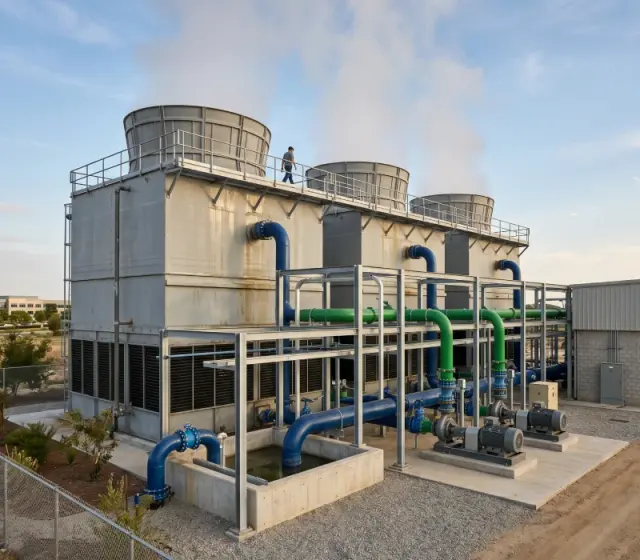
A cooling tower can consume more water than the process it serves when blowdown is controlled by habit rather than water chemistry. Opening a manual blowdown valve too far protects against scaling, but it also sends treated water, dissolved solids, and chemical residuals to drain. Closing it too much may reduce water use temporarily while increasing the risk of deposits, corrosion, biological growth, and unplanned cleaning.
Industrial cooling tower water optimization is therefore not simply a question of using less water. It is a controlled operating decision: how far can the tower concentrate dissolved minerals before water quality begins to threaten heat transfer surfaces, fill, spray nozzles, piping, pumps, and production reliability? The answer depends on makeup water chemistry, tower design, operating temperature, cycles of concentration, treatment controls, and the consequences of a failure.
Why cooling tower water use is difficult to control
Evaporation removes relatively pure water from the circulating system. Most dissolved minerals remain behind. As the tower continues to operate, calcium, magnesium, silica, chloride, alkalinity, suspended solids, and treatment chemicals become increasingly concentrated in the recirculating water. A portion of this water must be discharged as blowdown and replaced with makeup water.
Three flows determine the basic water balance:
- Evaporation: water lost as vapor during heat rejection.
- Drift: small droplets carried out of the tower with exhaust air.
- Blowdown: deliberately discharged circulating water used to control dissolved solids.
Makeup water must replace all three losses. Drift is normally controlled by tower design and eliminator condition. Evaporation is primarily linked to the heat rejected and the temperature range across the tower. Blowdown is the controllable component, but it cannot be set correctly without reliable measurement.
The central operating variable is the cycle of concentration, commonly expressed as the concentration of a relatively stable dissolved constituent in circulating water divided by its concentration in makeup water. Conductivity is often used as a control proxy, but conductivity alone does not identify which contaminant is limiting operation. A tower may have acceptable conductivity while silica, chloride, suspended solids, or microbiological conditions are already becoming problematic.
What cycles of concentration actually change
If a tower operates at a low cycle of concentration, it discharges more water because the dissolved solids are kept relatively dilute. This may provide a wider safety margin against scaling, but it increases makeup water, blowdown volume, chemical demand, and wastewater handling requirements.
As cycles increase, blowdown generally falls. However, the benefit is not linear forever. Moving from very low concentration to moderate concentration can reduce avoidable water losses. Moving from a moderate level to a much higher level may create disproportionate treatment and reliability challenges. The correct target is the highest stable operating cycle that the water chemistry and equipment can tolerate, not the highest number that can be achieved for a short period.
For a simplified balance, if evaporation and drift are represented by E and D, and the desired cycles of concentration are C, blowdown B can be approximated as:
B = (E + D) divided by (C - 1)
Makeup M is then approximately E + D + B. This simplified relationship assumes steady operation and similar dissolved-solid concentrations in makeup and blowdown. Actual calculations should account for leakage, undocumented drains, variable loads, chemical additions, and the specific control parameter used by the plant.
Illustrative water-saving calculation
Consider an illustrative cooling tower with 100 cubic metres per hour of evaporation and drift combined. At two cycles of concentration, the approximate blowdown requirement from the simplified equation is 100 divided by 1, or 100 cubic metres per hour. At five cycles, it becomes approximately 25 cubic metres per hour.
The theoretical reduction in blowdown is substantial, but this does not mean the plant can immediately change the conductivity setpoint from two cycles to five. The example excludes tower leaks, basin overflow, water quality limits, chemical control, and changes in heat load. It also assumes that the selected concentration indicator represents the actual limiting contaminant. Actual results depend on plant-specific operating conditions and laboratory analysis.
For a plant operating 6,000 hours per year, the illustrative difference between 100 and 25 cubic metres per hour would represent a large annual water volume. The financial value would depend on the cost of raw water, pretreatment, pumping, chemicals, wastewater treatment, discharge, and any production risk. In many plants, the avoided wastewater volume is as important as the avoided makeup water.
Start with a water chemistry and equipment baseline
Before changing blowdown settings, the plant should establish a baseline over representative operating conditions. A single sample taken during a stable production shift can be misleading. Cooling load, makeup water quality, ambient conditions, chemical dosing, and tower cleanliness may vary throughout the week.
A practical baseline should include:
- Makeup water conductivity, pH, hardness, alkalinity, chloride, silica, iron, suspended solids, and microbiological indicators where relevant.
- Circulating water conductivity, pH, temperature, hardness, alkalinity, chloride, silica, and treatment residuals.
- Actual makeup and blowdown flow, rather than only valve position or pump nameplate capacity.
- Supply and return temperatures, process load, approach temperature, and tower fan operating condition.
- Pressure drop across strainers, filters, heat exchangers, and other points where fouling may develop.
- Visible scale, corrosion products, algae, slime, sediment, or blocked spray distribution components.
Sampling locations matter. A sample from a poorly mixed basin may not represent the circulating loop. Instruments should be checked against laboratory results, particularly when a conductivity controller is being used to operate an automatic blowdown valve. A reliable water balance can reveal that the apparent blowdown problem is actually caused by a leaking valve, overflowing basin, faulty level control, or unmeasured drain.
Choosing the limiting water-quality parameter
Conductivity is convenient because it can be measured continuously and used for automatic control. It is useful for identifying general dissolved-solids concentration, but it is not a universal indicator of scaling or corrosion risk. The relationship between conductivity and individual ions changes with makeup water composition and treatment chemistry.
Hardness and alkalinity influence the potential for calcium carbonate deposition, particularly where heat-transfer surfaces operate at higher temperature or where local concentration occurs.
Silica can become a concern at higher concentration levels because deposits may be difficult to remove and may affect heat transfer. The acceptable operating range depends on water chemistry, temperature, pH, and the treatment program.
Chloride and other aggressive ions can increase corrosion risk, especially where metallurgy, crevices, deposits, or elevated temperatures create local attack conditions.
Suspended solids can foul fill, block nozzles, increase basin sediment, and reduce heat-transfer performance even when dissolved-solids readings appear acceptable.
Microbiological activity requires its own control strategy. Biocide residual and microbiological testing should be coordinated with the treatment program and site procedures. Raising cycles without managing biological growth can turn a water-saving project into a hygiene, maintenance, and reliability problem.
For this reason, the operating target should be based on the parameter most likely to limit the system, not automatically on a generic conductivity value.
Automation is valuable only when the control loop is trustworthy
Automatic blowdown control can reduce operator variability, but automation does not correct poor instrumentation. A typical arrangement may include a conductivity sensor, flow-controlled blowdown valve, makeup water meter, circulating water temperature measurement, level transmitter, and alarm functions connected to the plant control system or SCADA.
The control philosophy should address more than a single high-conductivity alarm. Useful functions can include high and low conductivity alarms, sensor fault detection, minimum and maximum blowdown limits, confirmation of actual valve movement, makeup and blowdown flow comparison, and manual override procedures. If the blowdown valve is open but no flow is measured, the system should identify the fault rather than assume that water quality is being controlled.
Sensor installation requires attention to flow velocity, air bubbles, electrical grounding, sample conditioning, access for cleaning, and representative location. A sensor placed in a stagnant side stream or immediately downstream of chemical injection may give unstable or misleading readings. Calibration and cleaning intervals should be defined as part of the operating procedure, not left to individual preference.
Automation should also preserve safe fallback operation. If the conductivity instrument fails, the plant needs a documented temporary control method based on laboratory testing and supervised manual operation. This is particularly important for cooling systems serving continuous processes where an uncontrolled tower condition could affect production.
How treatment and equipment choices affect the target
Increasing cycles is not only a chemical-treatment decision. It may require a coordinated review of filtration, side-stream treatment, corrosion control, scale inhibition, biological control, and makeup water pretreatment.
Side-stream filtration can remove suspended solids from a portion of the circulating water and reduce the load entering the tower basin and heat exchangers. The appropriate filter technology depends on particle size, flow rate, solids loading, available pressure, backwash requirements, and the quality of the water being returned to the system.
Makeup water pretreatment may also change the feasible operating window. Softening can reduce hardness, while membrane treatment can alter dissolved-solids loading. However, each option adds capital cost, reject water, maintenance requirements, and operating controls. Pretreatment should be evaluated against the actual limiting parameter rather than selected simply because it is a familiar technology.
Chemical treatment can help control scale, corrosion, and biological activity, but it should not be used to conceal an unbalanced water system. Excessive dosing may increase operating cost, complicate blowdown discharge, or create compatibility issues with seals, coatings, heat exchangers, and downstream treatment. Chemical suppliers and plant engineers should work from measured water chemistry and documented equipment metallurgy.
Where industrial applications require different approaches
Cooling tower optimization is highly application-specific. In a chemical plant, variable process loads and corrosive contaminants may require frequent review of chloride, pH, and metallurgy. A small water-saving gain is not attractive if it increases the probability of a heat-exchanger leak or process interruption.
In food and beverage manufacturing, cooling systems may support refrigeration, utilities, or process heat rejection. Hygiene requirements, cleaning schedules, and seasonal production changes can alter the appropriate treatment approach. The cooling tower water circuit should also remain clearly separated from process water and potable water systems according to site design and applicable requirements.
In automotive or general manufacturing facilities, cooling loads may change with shifts, ambient temperature, production mix, and equipment utilization. A fixed blowdown schedule can be especially wasteful in this environment because it continues discharging water even when the tower load is low.
In pharmaceutical facilities, reliability, controlled maintenance, and documented operation may carry more weight than maximizing cycles. A conservative water target with dependable monitoring can be preferable to an aggressive setpoint that introduces uncertainty into critical utilities.
Implementation risks and how to control them
The most common mistake is to increase the cycles of concentration in one step and wait for visible problems. Scaling and corrosion may develop gradually, while the cost appears later through reduced heat transfer, cleaning, tube replacement, or downtime.
A safer implementation is a controlled trial:
- Confirm the baseline water balance and laboratory results.
- Inspect tower fill, basin, nozzles, strainers, heat exchangers, and visible piping condition.
- Verify conductivity, flow, level, temperature, and pH instruments.
- Define a temporary operating target and escalation limits.
- Increase concentration in measured steps while tracking limiting parameters.
- Inspect equipment after an agreed observation period and compare results with the baseline.
- Document the final setpoint, sampling frequency, chemical controls, alarm response, and maintenance responsibility.
Space constraints can make side-stream filtration or additional dosing equipment difficult to install. Existing piping may not have suitable isolation points. Electrical and control modifications may require shutdown planning. These details should be identified during a site survey instead of after the project has been approved.
Enercon Worldwide can contribute to this type of assessment through industrial utility optimization, water treatment engineering, integration, and commissioning capabilities. The engineering scope should be based on the plant water balance, equipment condition, treatment objectives, and required operating reliability rather than on a preset package.
How to evaluate the business case
The financial case should include more than the value of water saved. A complete estimate may consider raw water, pretreatment, pumping, chemical consumption, blowdown conveyance, wastewater treatment, discharge handling, maintenance, instrumentation, and the cost of production risk.
An illustrative payback calculation might use the following structure:
- Annual water and wastewater savings: calculated from measured reduction in makeup and blowdown flow multiplied by operating hours and applicable tariffs.
- Annual chemical savings or additional treatment cost: based on actual dosing rates and chemical prices.
- Additional electricity use: included for filtration, pumps, controls, or pretreatment.
- Capital cost: instrumentation, valves, meters, filtration, pretreatment, automation, installation, and commissioning.
- Simple payback: capital cost divided by annual net operating savings.
For example, if a project costs 30 monetary units and produces measured net annual savings of 12 monetary units, the simple payback is 2.5 years. This is an illustrative calculation, not an industry benchmark or a guaranteed project result. Actual payback depends on tariffs, operating hours, water chemistry, load profile, maintenance requirements, and the performance achieved after commissioning.
Decision makers should also assign a value to avoided reliability events where this can be supported by plant records. The purpose is not to inflate the business case, but to compare a water-saving project fairly with the operational consequences of scaling, corrosion, or biological control failure.
A practical approval checklist
Before approving an industrial cooling tower water optimization project, the owner or utility manager should ask:
- What is the measured current cycle of concentration, and which parameter defines it?
- Are makeup and blowdown flows metered independently?
- Which dissolved or suspended contaminant is expected to limit operation?
- Do laboratory results support the proposed operating target?
- Are tower fill, heat exchangers, piping, and pumps suitable for the new condition?
- How will the system respond to sensor failure, chemical interruption, or abnormal makeup water?
- What additional filtration, pretreatment, or corrosion monitoring is required?
- How will the project be installed without exposing production to uncontrolled cooling risk?
- What will be measured after commissioning, and who owns the operating procedure?
A vendor proposal should state assumptions clearly. It should distinguish guaranteed equipment functions from expected water savings and identify the instruments, sampling, commissioning support, operator training, and post-startup verification included in the scope.
Make the next step a measured feasibility review
The best first step is not automatically to raise the conductivity setpoint. It is to build a short, reliable picture of the system: makeup quality, circulating-water chemistry, heat load, actual flows, equipment condition, current treatment, and operating variability. That information shows whether the opportunity lies in better control, filtration, pretreatment, chemical optimization, equipment repair, or a combination of measures.
Industrial cooling tower water optimization succeeds when water conservation is treated as a process-control and reliability project rather than a valve adjustment. A plant that measures the right parameters can often reduce avoidable water and wastewater costs while protecting heat-transfer performance. Enercon Worldwide can support a plant data review, utility assessment, and integrated evaluation of cooling, water treatment, instrumentation, and operating requirements before a final solution is selected.
Related Enercon solutions
Planning an energy or utility project? Talk to the engineers at Enercon Worldwide or request a consultation. You can also browse all our business areas.