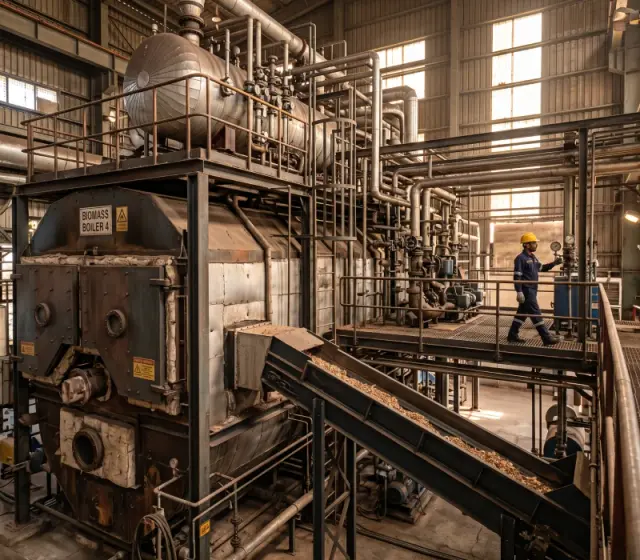
A prominent North Indian sugar mill reduced its annual steam costs by ₹3.1 crore after converting from coal to a high-efficiency biomass-fired boiler system—achieving thermal efficiency gains of 8%, higher CPCB compliance, and a payback in just under three years. Similar stories are playing out across Indian and GCC industries where biomass boiler upgrades are no longer a sustainability luxury but a compliance and cost optimization necessity.
Why Biomass-Fired Boilers Are Redefining Steam Generation for Industry
Many industrial plants—textile mills in Tamil Nadu, cement works in Gujarat, distilleries in Uttar Pradesh—wrestle with dual pressures: decarbonizing steam generation and keeping operating costs in check. Conventional fossil-fired package boilers (coal, oil, or natural gas) struggle to meet tightening emission norms and rarely deliver on both fronts.
In contrast, modern biomass-fired boilers, engineered for multifuel operations and consistent performance, utilize agro-residues or wood chips—fuels often available at 30–70% the cost of imported coal or furnace oil. With advanced combustion and automated fuel feeding, many plants are achieving stack emissions below 120 mg/Nm³ (PM), well within Indian CPCB and GCC regulatory thresholds.
Industry Applications: Biomass Boiler Success in Indian and GCC Sectors
Cement Plants: Process steam at 10–32 bar is critical for raw mill drying and power generation through waste heat recovery. Dalmia Cement (South) Ltd, for instance, integrated a 48 TPH biomass boiler, using rice husk and sawdust, to contribute 60% of its steam requirement. Result: ₹4.2 crore in annual fuel savings and true abatement of Scope 1 emissions—key for PAT scheme targets.
Distilleries: Spent wash and biomass are co-fired in specialized boiler systems, achieving both steam generation and zero-liquid-discharge capability. A leading Maharashtra molasses distillery replaced an oil-fired unit with a 24 TPH spent wash/biomass boiler, meeting ZLD and CPCB norms while saving over ₹2 crore per year in fuel and compliance costs.
Food Processing Plants: Steam is the energy backbone for blanching, drying, and sterilization. A Gujarat edible oil refinery swapped two aging oil-fired boilers for a single 20 TPH biomass water-tube boiler, consuming groundnut husk. Annual outcome: 90,000 tonnes less CO2, 18% lower OPEX, and thermal parity with oil-fired systems.
How Biomass-Fired Boiler Technology Works: Behind the Efficiency Gains
Modern biomass boilers—spanning 5 TPH packaged shell boilers to 100+ TPH water-tube installations—transform energy-rich sugars, rice husk, bagasse, wood chips, and even spent wash into high-pressure steam. Core subsystems include:
- Fuel Storage and Handling: Customized for local residue or chip feedstocks; automated conveyors reduce manual handling loss and improve dosing.
- Combustion System: Options like reciprocating grate, fluidized bed (AFBC/CFBC), and spouted bed enable low-NOx, multi-fuel combustion at 800–950°C, ideal for variable agro-residues.
- Heat Recovery: Economizers and air preheaters recover exhaust heat, boosting thermal efficiency to 86–91%, compared to 76–80% for legacy fire-tube boilers.
- Emission Control: Cyclone separators and bag filters ensure stack PM well below 150 mg/Nm³.
Boiler footprints range from compact 90 m² modules for 5–10 TPH to customized 400 m² installations for large complexes. Enercon Worldwide, for example, has engineered and commissioned 35–95 TPH biomass utility steam plants for distillery and paper applications across India and the GCC.
Energy Efficiency Achievements: Numbers That Matter
Traditional coal-fired fire-tube boilers in Indian industry average 78–82% thermal efficiency—with notable heat loss at the stack. In contrast, a modern biomass-fired water-tube boiler with economizer can achieve:
- 88–91% thermal efficiency (LHV) on agro-residues, per field audits in Indian cement and food processing plants
- Stack losses below 7–8% versus 14–18% in oil-fired systems
- Lower excess air operation via oxygen-trimmed combustion control, reducing unburned carbon and improving fuel yield
These gains translate directly into lower fuel input per tonne of steam. For a 40 TPH boiler operating 6,000 hours/year, an 8% efficiency gain reduces required fuel by over 2,700 tonnes annually—saving upwards of ₹56 lakh on a ₹2,000 per tonne fuel cost basis typical in India. When multiplied across multi-boiler installations, cumulative impact can exceed ₹2–4 crore per year.
Cost Optimization and ROI Analysis: Biomass Boiler Payback in India and GCC
The business case for biomass boiler upgrades is clear, provided capital is paired with high-load operation and local fuel contracts. Consider a 20 TPH biomass-fired water-tube boiler retrofit for a midsize Indian food processor:
- Total EPC investment: ₹7.5–9 crore, including emission controls and fuel handling
- Annual fuel savings: ~₹1.8 crore (switching from furnace oil at ₹70/liter to biomass at ₹6/kg, with 8,000 hours annual use)
- O&M cost reduction: ₹12 lakh/year (automation and lower breakdown rate)
- Compliance penalty avoidance: ₹20–50 lakh+ per year (fines avoided by meeting emission standards)
- Typical payback: 3–4.5 years (India), 2.5–4 years (GCC, with higher fuel price differentials)
Plants operating 6,000–8,000 hours per annum with steady steam demand achieve the fastest payback.
Real Industry Example:
An Enercon Worldwide biomass project for a rice mill (24 TPH setup, Punjab) replaced outdated 78% efficient coal boilers with 89% efficient multi-fuel units. The fuel switch achieved ₹95 lakh annual savings, cut CO2 emissions by 14,800 tonnes/year (certifiable for carbon credits), and delivered full cost recovery in 34 months.
Sustainability, Compliance, and Environmental Impact
Tighter emission norms across India and GCC states (e.g., CPCB’s 150 mg/Nm³ PM, CAQM’s 80 mg/Nm³ for NCR, and Saudi Vision 2030’s low-carbon mandate) are accelerating the migration to cleaner steam generation.
- CO2 emissions: Switching from coal to biomass cuts net GHG by 75,800 tonnes/year for a 60 TPH system.
- Water usage: Modern biomass units with dry ash handling consume 12–15% less water per tonne of steam than wet-bottom legacy systems. This is critical for ZLD compliance in textiles, distilleries, and food processing.
- Waste utilization: Many projects achieve near 100% utilization of local agro-waste, supporting circular economy goals and reducing landfill burden.
Importantly, for industries under the Perform, Achieve, and Trade (PAT) scheme, every percentage rise in boiler efficiency eases PAT cycle targets. Several Enercon clients have reported easier verification and reduced compliance expenditure under the scheme after biomass upgrades.
Risks of Inaction: Compliance, Penalty, and Cost Escalation
Delaying biomass boiler modernization exposes plants to real and escalating consequences:
- CPCB/State Board fines: Up to ₹30–50 lakh per incident of stack emission non-compliance for Particulate Matter (PM) or SOx breaches—a recurring risk with legacy coal/oil units.
- PAT penalties: Missed efficiency targets can mean purchasing expensive energy certificates (EECs) or facing direct fines. In the April 2026 PAT cycle, several cement and paper mills paid ₹40 lakh+ in compliance costs due to boiler inefficiency.
- ESG audit repercussions: Export clients increasingly require proof of sustainable, low-emission operations—a gap in boiler modernization can trigger contract loss or negative ESG grading.
- Rising fuel costs: Plants locked into imported coal or furnace oil face 18–22% YoY cost hike risk, especially during supply volatility as seen in late 2023.
Overcoming Implementation and Operational Challenges
No boiler retrofit is without hurdles. Common challenges across Indian and GCC plants include:
- Fuel seasonality and quality: Agro-residues vary in calorific value and moisture (rice husk: 2,200–2,800 kcal/kg, 18–33% moisture). Robust feed system design and onsite drying/storage solve 80% of performance variability.
- Space constraints: Existing boiler houses often require major civil works for larger fuel storage/treatment. Modular boiler skids and pre-assembled components mitigate downtime, with 38% of Enercon clients retrofitting in under 22 days per unit.
- Skilled manpower: Effective operation needs trained crew for fuel handling, emission control, and digital combustion tuning. Remote SCADA and Enercon’s digital O&M support closes the skills gap for many mid-tier plants.
- Integration with legacy systems: Migrating from oil/coal requires controls harmonization—Enercon Worldwide specializes in seamless DCS and plant utility tie-ins to minimize switchover disruption.
Technology Comparison: Biomass Boilers Versus Alternative Steam Systems
Key alternatives for industrial steam are:
- Conventional Coal-Fired Boilers: Typically 76–82% thermal efficiency; high SOx/NOx/PM emissions; under mounting regulatory pressure in both India and GCC.
- Oil/Gas Package Boilers: Cleaner than coal; quick-start but ~85% efficiency and beholden to rising global fuel prices.
- Modern Biomass-Fired Boilers: 86–91% thermal efficiency with high emission compliance; local fuel use; lower OPEX; modular expansion possible.
- Electric Boilers: Often promoted for ESG, but 30–60% higher operating costs per tonne of steam in India and GCC.
The optimal choice often comes down to local fuel availability, required emission limits, and project payback targets. In India, where biomass cost advantages and regulatory support are strong, biomass-fired solutions outperform alternatives on total cost of ownership and compliance assurance.
Deep Dive: Sector Applications and Real Configurations
Sugar Mills: Bagasse-Based Steam and Power
After crushing, 28–35% of cane weight is bagasse—a renewable fuel. Typical configuration: 80 TPH high-pressure water-tube boiler firing bagasse at 66 bar, supplying both process steam and backpressure turbine for in-house power. A recent Enercon Worldwide project in Uttar Pradesh achieved thermal efficiency of 90.4%, saving ₹2 crore annually by eliminating coal dependence in the ‘shoulder’ seasons.
Rice Mills: Multi-Fuel Flexibility
Rice husk-fired units, often 15–30 TPH, face high ash content and inconsistent fuel. Enercon’s solution: reciprocating grate designs with automated deashing, yielding stable steam for drying and parboiling—97% average annual plant uptime, 19% lower fuel cost than legacy fire-tube boilers.
Distilleries: Spent Wash & Biomass Boilers for ZLD
Spent wash co-fired with biomass delivers virtually zero liquid discharge steam generation, vital for CPCB and state board compliance. An example: 26 TPH boiler at a Maharashtra distillery, achieving 85% spent wash utilization (reducing waste loads by 24,000 kL/year), while meeting all emission and effluent limits.
Future Trends: Digital, Modular, and Decarbonized Directions
- Hydrogen/biogas co-firing: Next-gen grates are engineered for dual-fuel, enabling >15% hydrogen blends or 30% modular biogas, significantly lowering net CO2 in refineries and large paper mills.
- AI-driven combustion and predictive O&M: Real-time analytics for combustion tuning, fuel optimization, and maintenance scheduling—now standard in Enercon Worldwide’s latest projects.
- Modular and containerized solutions: Accelerating project timelines and enabling brownfield upgrades in plants facing space or load growth constraints. Modular boilers can scale from 10 TPH to 50 TPH with minimal civil works.
- Circular economy tie-ins: Advanced ash recycling and process integration enable byproduct utilization—e.g., in cement blending or fertilizer production.
Decision-Making Support: How to Select Your Biomass Boiler Partner
Checklist for Vendor and Technology Evaluation
- Local fuel compatibility: Proven long-term operation on your specific agro-residue, with real test certificates.
- Thermal efficiency guarantees: Written targets (min 86% LHV) and in-warranty testing.
- Compliance track record: Projects meeting < 120 mg/Nm³ PM and all state PCB-specific requirements.
- Integration services: Vendor capacity for DCS/Energy management tie-in and existing utility synchronization.
- O&M and training: Onsite and remote training, spares availability, digital O&M support.
- References and operating data: Named installations in your sector and region—verified annual savings and emission performance.
- Project lead time: Ask for typical delivery and commissioning timeline—8–14 months is the Indian/GCC market benchmark for 20–50 TPH installations.
If warning signs appear—such as chronic stack emission breaches, unreliable O&M support, or fuel procurement gaps—move rapidly, as delay typically multiplies plant costs and compliance risks.
Enercon Worldwide’s strength lies in bringing sector-specific expertise, regulatory navigation, and integrated O&M support to every biomass boiler project, from assessment to commissioning and beyond.
Taking the Next Step: Timelines, Assessment, and ROI Safeguards
For steam-demanding industrial plants in India and the GCC, targeting compliance for the April 2026 PAT cycle or aligning with ESG reporting, the window for ROI-positive biomass boiler upgrades is closing. With typical project cycles of 8–14 months from kick-off to steam-on, plant managers and EPC heads should prioritize a feasibility assessment—mapping current fuel spend, emission gaps, and available biomass contracts.
Enercon Worldwide recommends commencing with an on-site energy audit and fuel logistics study to quantify potential savings, compliance exposure, and payback. The criteria and checklist above equip decision-makers to proceed with confidence and clarity—whether retrofitting or planning a greenfield unit. With the right partner, you can turn compliance pressures and fuel market volatility into long-term competitive advantage.
Related Enercon solutions
Planning an energy or utility project? Talk to the engineers at Enercon Worldwide or request a consultation. You can also browse all our business areas.