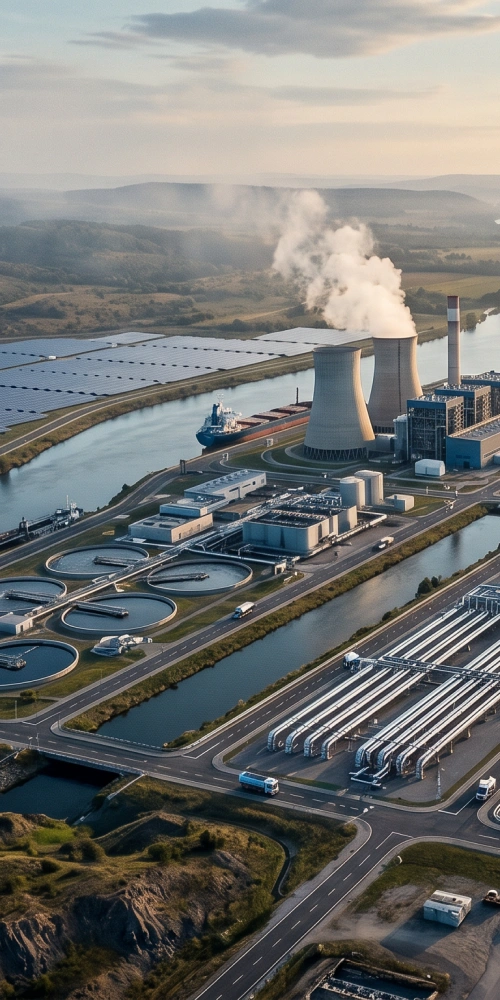
A sugar mill operating in Uttar Pradesh cut its annual coal import bill by ₹3.2 crore—and met its latest PAT cycle target—by switching to an on-site biomass power plant. For hundreds of similar industrial facilities, the question is no longer if biomass makes sense, but how fast they can deploy, integrate, and scale these solutions before the next regulatory or fuel price shock hits.
Biomass Power Plants: Industrial Use Cases and Sector Scenarios
Several industrial sectors in India and the GCC are now pivoting to biomass power plants as a dual strategy for energy cost control and environmental compliance. For instance, sugar mills generate large volumes of bagasse—a biomass residue used as boiler fuel—transforming waste into 30–70% of their captive power needs. Distilleries are deploying spent wash-fired boilers to reduce both effluent treatment and coal dependence, achieving up to 10 GWh/year of internal green electricity. Meanwhile, textile plants in Tamil Nadu are replacing furnace oil with rice husk biomass, slashing Scope 1 emissions and qualifying for state clean energy incentives.
Even high-resource users like paper mills, food processors, and chemical manufacturers are retrofitting old coal-fired CHP units with fluidized bed biomass boilers. In the GCC, agro-processing and food clusters are piloting modular biomass cogeneration to reduce grid reliance and lower carbon intensity, opening export markets demanding ESG-aligned supply chains.
How Biomass Power Plants Work: Technical Deep Dive for Industrial Applications
At the core, a biomass power plant converts solid organic fuel (bagasse, rice husk, wood chips, agro waste) into high-pressure steam for process use and electricity generation. Fuel is combusted or gasified in boilers—commonly water-tube or fluidized bed designs. Steam at 45–110 bar and 450–540°C powers turbines, delivering 1.5–60 MW electrical output for typical Indian industries.
Advanced automation and fuel feeding systems ensure stable combustion despite fuel variability. Modern plants feature:
- Boiler thermal efficiency: 86–91% (with economizer)
- Steam generation rates: 10–120 TPH (tons per hour)
- Cogeneration setup: 2–16 MW electricity + 10–100 TPH process steam
- Footprint: 600–5,000 m² for medium-scale units
Enercon Worldwide engineers tailor system capacity, pressure, and automation level based on fuel type, plant layout, and electricity/process steam demand profile—ensuring optimal integration and lifecycle reliability.
Quantifying Energy Efficiency Gains in Industrial Biomass Projects
Converting from old, low-pressure coal boilers (average 76–81% efficiency) to high-pressure, water-tube biomass boilers with energy recovery consistently delivers 8–15% improvement in overall conversion efficiency. For a 20 TPH plant with 7,000 annual operational hours, this translates to 1,500–2,900 tonnes less fuel burned per year, depending on fuel type and calorific value.
In a recent Enercon Worldwide project for a Karnataka-based starch producer, upgrading to a 35-bar biomass boiler with fully digital controls yielded:
- 12.5% reduction in specific steam consumption (kg steam/kg product)
- Boiler uptime increased from 320 to 345 days/year
- Annual fuel savings: ₹1.8 crore compared to baseline
These benchmarks are crucial for energy managers reporting under the PAT scheme or aligning with ISO 50001 objectives.
Cost Optimization: Realistic Payback and OPEX Analysis
The capital investment for an industrial-scale (20–50 TPH) biomass power plant in India typically ranges from ₹8–15 crore, depending on automation, fuel handling, and emissions controls. Fuel price volatility is dramatically reduced—biomass costs (₹2.5–4/kg) are stable versus imported coal or oil (₹8–11/kg).
Payback Example: A paper mill in Gujarat replaced two 15 TPH coal boilers with a 30 TPH biomass CHP system:
- Biomass fuel cost: ₹3.2/kg
- Steam cost reduction: From ₹2,650 to ₹1,500/tonne (annual generation: 150,000 T)
- Annual energy bill savings: ₹1.7 crore
- Additional revenue from 5 MW grid sale: ₹2.2 crore/year (at ₹4/unit)
The total project delivered a fully recovered payback in just under 3.2 years, even after factoring in increased O&M and ash management costs. In most Indian market contexts, paybacks run 2.5–4.5 years—often beating standard solar or wind ROI timelines for captive users needing process heat.
Sustainability, Emission Reduction, and Compliance Acceleration
Switching to biomass dramatically boosts sustainability metrics. Every 1 tonne of coal replaced by bagasse or agro-waste biomass avoids 1.8–2.1 tonnes of CO2 emissions. For a mid-sized textile unit consuming 40,000 tonnes of steam annually, this equates to over 42,000 tonnes CO2 avoided per annum—well within typical site GHG reporting targets.
Complying with revised CPCB and CAQM stack emission norms (< 100 mg/Nm³ PM for new boilers, 2025 onward) is far simpler with modern biomass technologies equipped with multi-cyclone and bag filter dust arrestors. Under PAT scheme cycles, switching to biomass-fired systems typically reduces SEC (specific energy consumption) by 7–18%, supporting ‘Achiever’ classification and sidestepping non-compliance fines. The minimum achievement is often ₹25–60 lakh/year penalty avoidance per PAT cycle for medium-to-large plants.
The Cost of Delaying Biomass Power Plant Adoption
Failure to modernize aging solid-fuel boilers exposes plants to escalating fuel costs, lost PAT incentives, CPCB fines, and reputational risk. In 2023 alone, Maharashtra PCB issued 120+ closure notices to units exceeding new PM emission limits. With the 2025 emission standards and Scope 1 ESG audit pressures, plants that stall face:
- Fines up to ₹10 lakh per incident for non-compliance
- Lost production from mandatory shutdowns (₹30–50 lakh/month typical impact for mid-size units)
- Missed export orders due to poor ESG ratings
- Escalating OPEX—old boiler fuel premiums often hit ₹70–80 lakh/annum
Enercon Worldwide’s site audit teams routinely identify avoidable losses of ₹1–2 crore/year resulting from inaction on boiler upgrades or fuel switching.
Overcoming Operational Challenges in Biomass Power Plant Deployment
While the benefits are clear, industrial deployment of biomass power plants presents several practical hurdles. Chief among them is fuel variability—in calorific value, ash content, and moisture—which can destabilize combustion and steam quality if not diligently managed. Solutions include pre-processing (drying, sizing), robust fuel yard planning, and automation of feed mechanisms.
Space constraints are another real factor, especially in brownfield retrofits. Fluidized bed boilers offer more compact footprints versus conventional reciprocating grate types. Integrating with existing process steam grids and utility SCADA systems requires skilled engineering and well-sequenced shutdowns—Enercon Worldwide typically plans retrofits over scheduled annual maintenance to minimize production loss. Finally, skilled O&M is essential; capacity-building and remote monitoring are now standard to ensure long-term performance.
Biomass Power Plant Technology Comparison: Selecting the Right Solution
Industrial buyers face choices between technology platforms. Circulating Fluidized Bed Combustion (CFBC) and Atmospheric Fluidized Bed Combustion (AFBC) handle high-ash/low-calorific fuels better than fixed grate boilers. CFBC units, for example, reach 89–92% efficiency versus 82–86% for dated fixed grate designs, and process higher throughputs (up to 120 TPH).
Biomass vs. Coal Boilers:
- Fuel cost: Biomass (₹2.5–4/kg) vs. Steam coal (₹8–11/kg, with import risk)
- CO2 emission: Biomass is carbon-neutral; coal releases 1.8–2.1 TCO2 per T
- Stack emissions: Modern biomass with bag filters achieves much lower PM than most retrofitted coal units
In scenarios prioritizing flexibility and automation, PLC-integrated, fully-modular biomass packages are preferred for brownfield upgrades. Plants with high resource variability (e.g., sugar, agro, paper) benefit most from multi-fuel, fluidized bed platforms, a domain where Enercon Worldwide delivers tailored solution engineering.
Sector-Specific Case Studies: Operational Impact and ROI
Sugar Mill – Bagasse-Based Power
An 8,000 TCD sugar mill in Karnataka leveraged bagasse-fired boilers to meet 68% of internal electricity demand, selling 4.2 MW surplus to the grid and reducing external power purchases by ₹1.6 crore per annum. Stack emissions now comply with < 80 mg/Nm³ PM norm.
Food Processing – Rice Husk to Steam
A rice bran oil extraction unit in West Bengal replaced three furnace oil-fired boilers with a 16 TPH water-tube biomass package. Result: 11.2% reduction in fuel spend, 15,700 tonnes annual CO2 mitigation, compliance with state PCB norms, and a 3.1-year project payback.
Distillery – Spent Wash Integration
A Maharashtra distillery deployed a spent wash-fired fluidized bed boiler with multi-cyclone dust collection, eliminating 10,000+ tonnes liquid waste/year and avoiding ₹60 lakh/yr in ETP operating and effluent trucking costs. The project achieved 20% ROI in under 36 months, with Enercon Worldwide supporting integration and commissioning.
Trends Shaping Biomass Power Plants over the Next Five Years
Industrial biomass systems are converging with several disruptive trends:
- Hydrogen Co-Firing: Early trials in the GCC—gas cofiring up to 20% hydrogen in biomass grids—are showing promise for rapid CO2 intensity reduction.
- AI-Powered Predictive Maintenance: Indian plants are investing in sensor-driven SCADA with machine-learning algorithms—reducing forced outage rates below 3% and enabling smarter fuel scheduling.
- Carbon Credit Optimization: Biomass projects now routinely monetize 10,000–50,000 tCO2e per year in voluntary and compliance carbon trading schemes, providing bottom-line value and supporting export claims.
- Modular Skid Systems: Projects are trending toward containerized, quick-deploy plants—especially for agro, textile, and food clusters facing land availability pressures.
Enercon Worldwide is actively innovating and delivering partnerships in these areas, aligning with customer carbon neutrality and digital transformation journeys.
Checklist for Selecting and Justifying Biomass Power Plant Investments
Many procurement and technical teams struggle to translate the vast opportunity into clear project decisions. The following checklist clarifies key questions for effective evaluation:
- Feedstock Reliability: Is your supply chain for primary and backup biomass proven year-round?
- Permitting & Compliance: Can your design meet local CPCB, PCB, and PAT requirements out-of-the-box?
- Integration: What is the downtime risk and compatibility with your process steam or grid?
- Efficiency Terms: What is the expected steam-to-fuel and electric yield ratio under real loads?
- OPEX and Maintenance: Is your O&M team ready? Will your vendor supply training and digital monitoring?
- Financial Case: Does your model account for fuel price hedging, carbon credit revenue, and PAT incentives?
Bringing in an engineering partner like Enercon Worldwide early ensures technical and compliance blind spots are closed well before capex is committed.
Moving Forward: Timelines, Next Steps, and The Compliance Clock
For most Indian industrial users, boiler projects—whether greenfield or retrofit—require 8–14 months from order to commissioning. With the next PAT compliance cycle beginning April 2026, and new CPCB/CAQM emission norms now enforceable, the real risk is project delay. Facilities relying on old coal or oil systems should initiate detailed feasibility and site-assessment studies immediately to ensure on-time commissioning by the deadline.
Enercon Worldwide offers comprehensive energy audits, scenario modeling, and owner’s engineering to de-risk major upgrades. Whether your motivation is fuel price control, accelerated compliance, or unlocking export markets, aligning technical, commercial, and operational priorities early translates to bottom-line results—and regulatory peace of mind.
Evaluate your biomass power plant options against the checklist above. If you require a tailored feasibility assessment or support in developing a PAT-compliant, ROI-positive project plan, connect with a specialist engineering partner. Ensuring momentum now is the surest way to secure long-term efficiency, sustainability, and compliance gains for your plant.
Related Enercon solutions
Planning an energy or utility project? Talk to the engineers at Enercon Worldwide or request a consultation. You can also browse all our business areas.