Cement makers in Gujarat have begun to realize that every year, ₹3–7 crore worth of usable energy simply escapes from process exhaust—enough to power their entire raw mill or cut specific fuel consumption by 15%. As CPCB’s energy efficiency mandates tighten and fuel prices remain volatile, waste heat recovery boilers (WHRBs) have moved from an efficiency ‘nice-to-have’ to a competitive necessity. For plant managers, the question isn’t “if” but “how fast” to retrofit – and what financial, operational, and compliance factors must be weighed to unlock maximum value.
Industrial Use Cases: Where Waste Heat Recovery Delivers Transformative Value
Waste heat recovery boilers are most impactful in industries with high-temperature process exhaust streams. In India and the GCC, cement plants, steel rerolling mills, glass manufacturing, chemical processing units, and distilleries see the best ROI due to their sustained heat losses via flue gases. For example, a 6000 tpd clinker cement plant in Rajasthan can recover up to 35–37 MWth from preheater and cooler exhaust, translating to 7–9 MW of electrical generation at 28% conversion efficiency. In the steel sector, reheat furnaces in rolling mills often operate at stack temperatures above 900°C, with 18–22% of furnace energy available for recovery—enough for steam generation that powers in-house utilities or export to the grid under open access schemes.
Distilleries with spent wash incineration, chemical plants with exothermic reactors, and fertilizer units venting synthesis gas are now routinely evaluated for WHRB integration. Enercon Worldwide has engineered 8.5 TPH waste heat recovery boilers for an agrochemical plant in Maharashtra, enabling generation of over 62,000 T/year of process steam, directly offsetting natural gas consumption.
How Waste Heat Recovery Boilers Work: Core Technology and Engineering Specifications
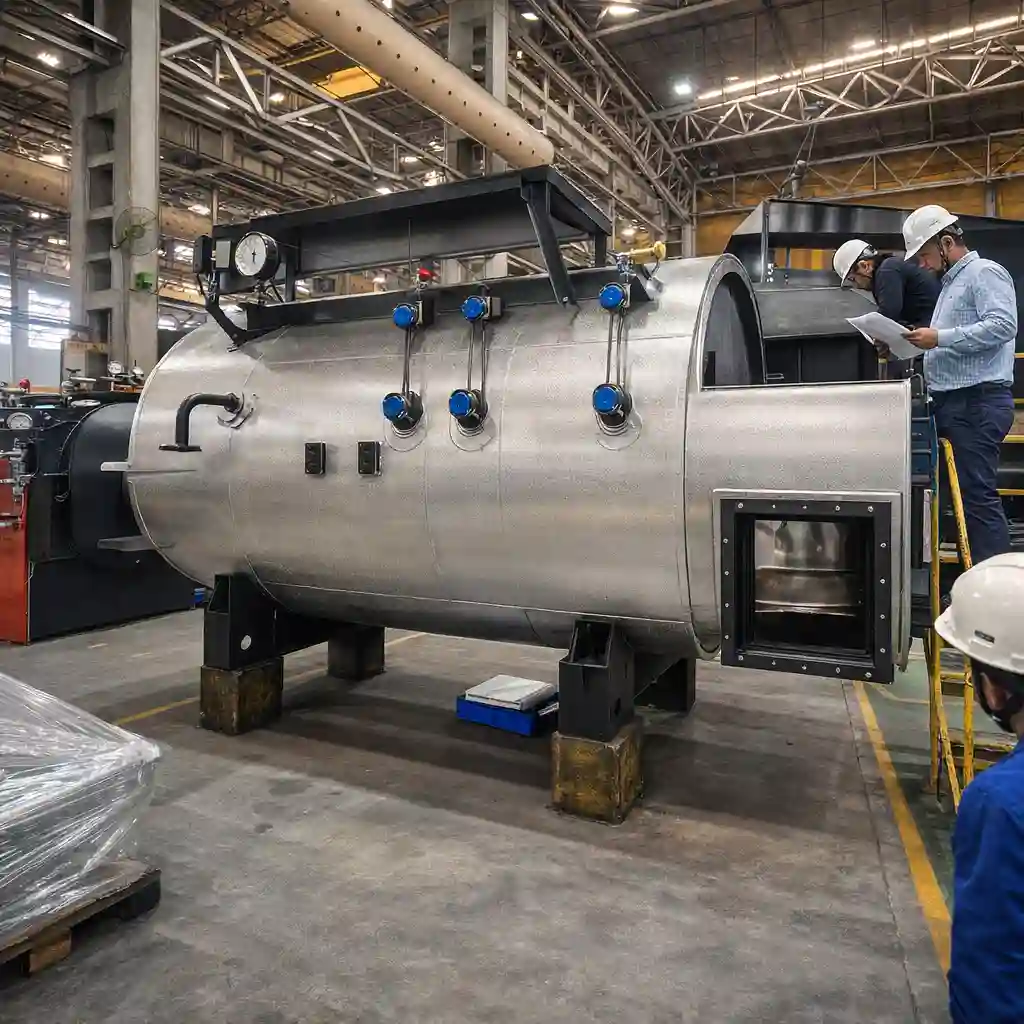
At their heart, waste heat recovery boilers transfer available heat from exhaust gas or process streams to generate steam, hot water, or, via subsequent turbine, electricity. Unlike standard boilers with dedicated burners, WHRBs use the ‘waste’ heat as their primary thermal energy source. Typical industrial WHRBs are water tube designs, ensuring rapid heat transfer and safe operation under high-pressure conditions (commonly 18–45 barg for steam generation in process industries).
Key Engineering Parameters:
- Capacity range: 2 TPH to 50+ TPH for standard industrial models; custom-engineered units up to 120 TPH for mega cement/steel plants.
- Operating temperatures: Can utilize exhaust gases from 250°C up to 1,100°C; most efficient above 350°C.
- Typical thermal efficiency: 70–85% (incremental, as they harness residual energy).
- Pressure ratings: 10–65 barg, configurable for process or power use.
- Footprint: Modular WHRBs now as compact as 30 m² for 6–8 TPH capacities, easing brownfield integration.
Enercon Worldwide customizes WHRB solutions for a wide range of fuels and exhaust chemistries, ensuring optimum material selection (e.g., alloy grades for acid dew point corrosion) and safe automation, even when retrofitted to aging process lines.
Quantified Energy Efficiency Gains: What Industrial Plants Can Realistically Achieve
Waste heat recovery delivers demonstrable, audited efficiency improvements. In cement plants, overall specific thermal energy consumption can drop by 65–80 kcal/kg clinker (about 6–12% savings), depending on exhaust source temperatures and seasonality. Steel rerolling mills utilizing WHRBs for process steam see fuel consumption reductions of 13–18%. For every 1 MW of process heat recovered, expect annual coal savings of 2,400–2,800 tonnes—a ₹1.8 to ₹2.2 crore per annum impact at ₹7,500/t fuel price.
Manufacturers moving from zero recovery to integrated WHRBs consistently report boiler efficiency increases of 4–8 percentage points. Even retrofits on 10–15 year old lines typically yield energy ROI within 2–3 years where continuous exhaust sources exist.
Cost Optimization and Payback Analysis: Financials That Stand Up to Scrutiny
Capital expenditure for industrial WHRB systems varies: direct heat-to-steam projects for small and medium process lines (5–10 TPH) run ₹1.1–1.6 crore per TPH installed, inclusive of heat exchangers, steam drums, controls, and site integration. For large process plants or power generation configurations, capex may reach ₹2.2–3 crore/MW electrical output (including the downstream steam turbine/generator set).
Worked Example: 3500 TPD Cement Plant
- WHRB capacity: 28 TPH
- Steam cost offset: ₹3.65 crore/year (assuming captive coal-fired steam at ₹1,400/tonne)
- Electricity savings: 4.9 MW generated, offsetting grid consumption worth ₹4.2 crore/year (at ₹7/unit tariff)
- Total WHRB project cost: ₹35 crore
- Payback period: 2.6 years (not factoring carbon credits or RPO compliance incentives)
Plants in the GCC see similar economics, though primary drivers are gas price volatility and grid independence. Enercon Worldwide supports CAPEX/OPEX modeling to determine the most bankable project configuration for each plant’s steam and power needs.
Sustainability, Emissions Reduction, and Regulatory Compliance
WHRB implementation directly supports compliance with India’s Perform, Achieve and Trade (PAT) scheme, which mandates sector-specific energy reduction targets. A mid-sized chemical plant with a 12 TPH WHRB installed by Enercon in 2022 reduced its annual CO2 emissions by 18,400 tonnes, directly evidencing conformance for their PAT cycle audit. In cement, Power-to-Heat and Heat-to-Power pathways with WHRBs help meet the Central Pollution Control Board’s (CPCB) requirements to ‘recover and reuse waste energy streams,’ frequently cited in plant environmental clearances.
Quantified Impact: For every 1 MW of electricity generated from waste heat, annual CO2 reductions of 7,600–8,300 tonnes are typical versus grid electricity based on India’s current grid emission factor. In the GCC, stricter MEPA and Saudi Arabia’s Vision 2030 efficiency norms make waste heat recovery a strategic lever to future-proof environmental compliance.
The Hidden Cost of Inaction: Compliance Risk and Lost Opportunity
Delaying waste heat recovery investments now comes with concrete risks. CPCB’s 2020 guideline circular enables state boards to halt new capacity expansion or revoke CTOs for plants “systemically failing to deploy energy recovery from eligible exhausts.” Textile dyeing and large paper mills in Tamil Nadu have been served closure notices when unable to show waste heat utilization as part of their water recycling compliance.
Under the PAT scheme, failure to achieve assigned SEC (Specific Energy Consumption) can result in penalties of ₹10–₹12 lakh per 1,000 TOE shortfall or the need to purchase compliance certificates at variable market prices. Beyond regulatory costs, missed energy recovery means enduring high, avoidable OPEX year on year—a silent but compounding drain on margins.
Operational Challenges and How Industrial Plants Are Overcoming Them
Common operational hurdles for WHRB deployment include:
- Exhaust variability: Processes with fluctuating loads (e.g., batch chemical reactors) require flexible control logic and on-demand bypass pathways. Enercon Worldwide configures advanced control systems to safeguard boiler health during low-load episodes.
- Corrosive gas streams: Sulphur- or chlorine-rich exhaust (not uncommon in fertilizer and metal finishing) demands superalloy or coated heat transfer surfaces and stricter condensate management.
- Space constraints: Brownfield retrofits in legacy plants often confront footprint shortages near the exhaust stack. Compact, modular WHRBs, now as small as 2.5m x 7m per 5 TPH unit, address this.
- Integration downtime: Planned outages must be minimized; best-practice retrofits are achievable within major turnarounds, with Enercon’s commissioning teams delivering reliable handover within 6–12 weeks on-site for TPH class projects.
In each case, selecting an experienced engineering partner is essential for designing the correct system and minimizing the learning curve.
Technology Comparison: Modern WHRBs Versus Conventional Approaches
The business case for modern waste heat recovery is strengthened by significant advances over earlier generations and ‘do nothing’ approaches. Traditional process boilers waste up to 35% of input energy via stack losses. Simple air preheaters or economizers recover only a fraction—typically 5–8%—and rarely deliver usable process steam or power.
Modern WHRB Advantages:
- Heat-to-power conversion: Integration with steam turbines for true electricity offset (not possible with simple recovery coils).
- Precision controls: Automated bypass, continuous stack monitoring, real-time remote analytics via integrated SCADA/PLC (increasingly demanded by newer ESG reporting and CAQM compliance).
- Durability and safety: Robust metallurgy and water chemistry management handle harsher exhaust chemistries sustainably.
In direct comparison, modern modular WHRBs deliver 2–3x more energy recovery per square meter footprint than legacy units, with less operator intervention and lower annual maintenance requirements.
Sector-Specific Deep Dives: Real-World Applications and Results
Cement Plant – Rajasthan
Challenge: Preheater and rotary kiln exhaust temperatures above 300°C, severe coal cost volatility.
Solution: 32 TPH water tube WHRB, direct steam fed to turbo-generator.
Outcome: 6.7 MW captive electricity, payback within 2.4 years, PAT points surplus generated, 58,000 t/y CO2 avoided.
Pharmaceutical Manufacturing – Hyderabad
Challenge: Batch process reactors venting 260–320°C flue, ambition for green steam targets.
Solution: 5 TPH compact, modular WHRB, fully automated for variable flow.
Outcome: ₹1.7 crore OPEX savings/year, reduced steam-specific energy by 14%, aligned with zero fossil-fired boiler roadmap.
Steel Rolling Mill – Maharashtra
Challenge: Reheating furnaces emitting >900°C exhaust; grid tariffs touching ₹9/unit.
Solution: 10 TPH WHRB with waste-to-steam for co-located process heating.
Outcome: 4.3 MWth captured, 19% reduction in furnace fuel demand, downtime on integration contained to 14 days (Enercon project data).
Future Trends: Where Waste Heat Recovery Is Headed
The next 3–5 years will see several innovations in industrial WHRB deployment:
- Hydrogen co-firing: R&D on “hydrogen ready” heat recovery boilers will enable decarbonized operations as green H2 pipelines mature in India’s industrial parks by 2027–28.
- Predictive maintenance: AI-driven condition monitoring will forecast fouling and corrosion risk, allowing up to 30% longer between manual cleaning shutdowns and reducing unplanned outages.
- Modular, prefabricated WHRBs: Factory-built modules cut field erection time by 30–50%, crucial for brownfield plant timelines.
- Integration with SCADA/Industry 4.0: Live dashboards for heat balance and energy KPIs now support both compliance and real-time OPEX optimization.
- Carbon capture synergies: Emerging design allows flue gas from WHRB outlets to go directly into carbon scrubbers, stacking emissions compliance benefits cost-effectively.
Enercon Worldwide is actively engaged in adapting all major new WHRB projects to accommodate these technical trajectories, ensuring future-proof investment for our clients.
Decision-Making Guide: How to Choose the Right Waste Heat Recovery Boiler Solution
Investing in waste heat recovery is a capital-intensive decision—success demands precise matching of system to process, and careful partner selection. Here’s a practical evaluation checklist:
Key Criteria to Review:
- Source exhaust analysis: Is the heat source continuous, at adequate temperature, and stable in chemistry?
- Steam vs. power needs: Will the recovered heat be best utilized for process steam, heating, or converted to electricity?
- Available footprint and access: Can a modular or custom WHRB fit within the existing plant layout without major civil works?
- Integration timeline: When is the next planned shutdown—can install and commissioning be coordinated to minimize process disruption?
- Partner experience: Does the engineering provider, such as Enercon Worldwide, have a proven track record of sector-specific WHRB deployment at the necessary scale?
- Compliance considerations: Will the system documentation and controls facilitate PAT, CPCB, or other required reporting/auditing?
A structured feasibility study, ideally led by an independent utility or with an experienced EPC like Enercon, is the safest step forward.
Strategic Next Steps and Why Acting Now Delivers Long-Term Advantage
India’s regulatory and cost environment has set a clear direction: by 2026, failure to recover eligible waste heat will mean rising penalties, blocked expansion, or both. Projects of even 10–15 TPH scale require 8–13 months from concept to commissioning—with meaningful OPEX and emissions savings flowing only after full handover and stabilization.
The logical next step for plant decision-makers is a detailed waste heat mapping and feasibility assessment, benchmarking against sectoral best-practice norms. Enercon Worldwide is partnered with many of India’s and the GCC’s leading cement, steel, and chemical industries to facilitate these audits, design tailored recovery solutions, and execute end-to-end WHRB projects with a compliance-first mindset.
In summary, advancing a WHRB investment is not just an energy project, but a business resilience strategy—delivering CAPEX payback within 2–3 years, annual emissions reductions of 8,000–60,000 tonnes, and ensuring that the plant stays ahead of both boardroom and regulatory demands. The longer the delay, the greater the risk of missed PAT cycle targets, higher OPEX, or regulatory disruption. For plants seeking to sustain growth, protect margins, and secure energy self-sufficiency, acting now is the most practical path—and Enercon Worldwide is ready to support with unbiased technical expertise from assessment through commissioning.
Related Enercon solutions
Planning an energy or utility project? Talk to the engineers at Enercon Worldwide or request a consultation. You can also browse all our business areas.