Regulatory pressure isn't on the horizon—it’s already reshaping India’s manufacturing sector. A textile unit in Surat faced a 72-hour closure notice due to non-compliance with CPCB’s ZLD (Zero Liquid Discharge) mandate. Retrofitting with a modular ZLD system not only restored operations but cut fresh water consumption by 85% and avoided recurring fines averaging ₹24 lakh per year. For plant directors and energy managers, ZLD is no longer a compliance checkbox—it's a critical lever for license-to-operate, cost optimization, and reputational risk management in India’s increasingly scrutinized industrial landscape.
Industrial Use Cases Driving ZLD Adoption: From Textiles to Pharma and Chemicals
Textile processing, pharmaceutical manufacturing, and specialty chemicals are the sectors most acutely impacted by ZLD regulations. Textile clusters in Tamil Nadu, Gujarat, and Punjab have faced state PCB actions enforcing near-total effluent recycle. In Ambur, a 1,200 m³/day tannery cluster’s shared ZLD plant made it possible to maintain operations during water-scarce periods—reducing ground water extraction pressure by 70% while meeting export buyer demands for green certification.
In pharma, bulk drug manufacturers in Telangana’s Jeedimetla zone are targeted for ZLD under the CAQM, driven by high TDS and difficult-to-treat APIs in their effluent. Chemical plants discharging into inland water bodies in Maharashtra must now achieve ZLD or face closure under local PCB actions, as even advanced ETPs are insufficient to meet 100% reuse targets. Paper mills, distilleries, dyes & pigment units, and food processing plants increasingly face similar mandates, particularly where water stress or sensitive catchments exist.
How Zero Liquid Discharge Works: Process Flow, Engineering Specs, and Plant Configurations
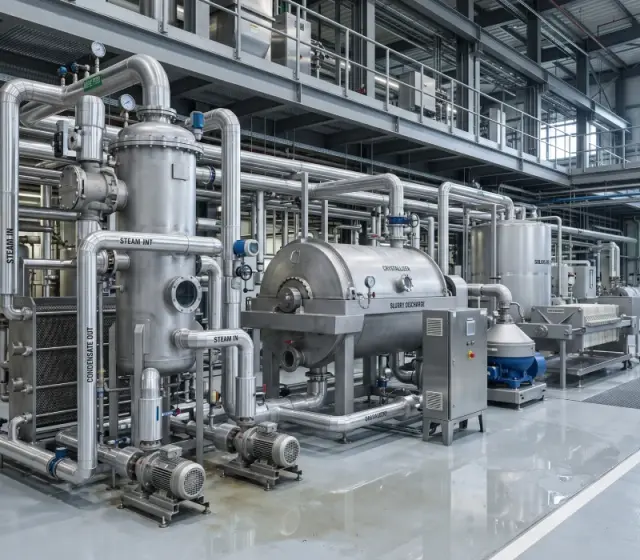
ZLD goes beyond conventional effluent treatment by recovering nearly all water from wastewater streams, yielding only dry, solid residues and zero liquid discharge to the environment. The typical system integrates multiple core components:
- Pre-Treatment: Screening, chemical dosing, equalization, and biological treatment to remove organics and solids.
- High Recovery Membranes: Reverse Osmosis (RO) or Nanofiltration removes dissolved solids, enabling 75–85% water recovery in initial stages.
- Concentrators & Evaporators: Mechanical vapor recompression (MVR) or multi-effect evaporators (MEE) reduce RO reject to a saline slurry.
- Crystallizers: Convert the slurry to dry solid salts for safe disposal; water vapor from this step is condensed and recovered.
- Polishing & Reuse: Purified water is returned to process uses, cooling towers, or boilers.
Capacity ranges vary from 20 m³/day for decentralized batch plants (common in pharma and specialty chemical production), scaling to 5,000–10,000 m³/day for textile clusters or large refineries. Operating temperatures in evaporators run from 60–120°C; system footprint for a 500 m³/day ZLD module typically requires 400–750 m², depending on layout and integration. RO membrane selection, evaporation technology, and automation (SCADA integration) are key technical decision points affecting footprint, energy consumption, and O&M complexity.
Energy Efficiency Insights: Managing the ZLD Power Draw
A core concern is ZLD energy demand, especially in evaporation stages. RO-based preconcentration typically consumes 1.5–2.5 kWh/m³ permeate, while MEE/MVR vapor compression systems for concentrate management require 22–30 kWh/m³ (mixed feed basis). Properly engineered plants, as implemented by Enercon Worldwide in 4,000+ m³/day textile applications, consistently deliver 90–94% water recovery with energy intensity benchmarks as low as 17–20 kWh/m³ (total system) when thermal vapor recompression is employed.
Newer ZLD plants can leverage process integration by utilizing low-grade steam or waste heat from cogeneration systems, cutting grid electricity demand by up to 30%. When compared to legacy ETPs (which only achieved 60–70% recovery), modern ZLD plants provide a 20–25% better water efficiency, directly reducing make-up water costs and minimizing reliance on borewell sources, which are increasingly restricted by state water boards.
Financial Analysis: Payback, Opex, and Real Cost Outcomes
Capital costs for industrial ZLD plants in India currently range from ₹16 lakh (20 m³/day pharma batch unit) to ₹22–30 crore (2,000–3,000 m³/day textile cluster). Typical total installed cost is ₹1,00,000–1,40,000 per m³/day, depending on effluent complexity, automation, and salt load. Operating costs are dictated by energy (~60–70%), chemicals (~15%), and membrane/consumables (~10%).
Worked Example – Textile Plant, Gujarat, 1,000 m³/day Effluent:
- Capex: ₹11 crore total delivered and commissioned, including RO + MEE + crystallizer
- Opex: ~₹38/m³ processed (mainly electricity at ₹7.8/unit and steam at ₹2,300/tonne)
- Fresh Water Cost Offset: ₹24/m³, annualized value for 85% water recovery
- Penalty Avoidance: Previous annual closure risk (with fines) exceeding ₹1.2 crore/year
- Payback Period: 3.2–4.1 years (conservative, factoring water offset, closure avoidance, and Opex)
Enercon Worldwide’s ZLD deployments in the GCC (notably UAE paper and Saudi chemicals) achieve comparable ROI, with faster payback—2.5–3.5 years—where water purchase tariffs exceed $1.7/m³ and non-compliance penalties are more severe.
Sustainability, Compliance, and the Impact of ZLD on Industrial Water Footprints
Modern ZLD not only meets but exceeds CPCB and state PCB discharge requirements, ensuring that treated effluent meets ZLD targets (zero liquid discharge, with <0.1% unrecoverable brine). For a 1,000 m³/day unit, this equates to 300,000+ kilolitres of water recycled annually and a reduction of 80,000–120,000 tonnes of effluent load released to groundwater or surface drain. Real-world data shows CO2 avoidance of 450–900 tonnes/year as electrical and chemical consumption for water extraction and effluent transport is reduced.
CPCB/State PCB Norms: Under the 2015–16 directives, zero liquid discharge is mandatory for many textile, bulk drug, and chemical plants in water-stressed or environmentally sensitive zones; Tamil Nadu PCB and Gujarat PCB have set the strictest enforcement. For pharma and tanneries, the ZLD mandate is now directly tied to renewal of Consent to Operate (CTO) and Environmental Clearance (EC), with verification audits every six months. In the GCC, Abu Dhabi’s EAD and Saudi’s PME have adopted ZLD mandates for select chemical, metal, and petrochemical plants, especially those tied to industrial water reuse.
The Cost of Non-Compliance: Fines, Production Loss, and Brand Risk
Plants delaying ZLD face fines that can rapidly exceed ₹10–30 lakh per closure notice and criminal penalties for managers in cases of groundwater contamination. In Gujarat’s textile belt, plants lacking ZLD have faced production shutdowns of up to 60 days; lost revenues can easily top ₹4–8 crore per facility for a single enforced closure. International buyers (apparel, pharma APIs) increasingly require third-party ZLD certification for orders, so non-compliance threatens not just direct costs but long-term export viability and ESG audit failures.
For sites already under Environmental Surveillance Mechanism (ESM), the cost of inaction can include tarred relationships with local communities, difficulties in consent renewals, and up to 20–30% water supply curtailments by local authorities. In summary, the cost of delay is almost always greater than the investment in ZLD implementation—particularly as enforcement tightens for the coming five-year period.
Operational Challenges and How to Solve Them in ZLD Implementation
Main Challenges:
- Variable Feed Quality: Fluctuating effluent composition causes membrane fouling, scaling in evaporators, and salt deposition. Plants must invest in robust pre-treatment and online monitoring (e.g., pH, TDS sensors with SCADA-enabled alarms).
- High Energy Demand: Thermal stages drive elevated Opex. Effective integration with existing steam/CHP systems, or use of waste heat, can mitigate (a typical 1,000 m³/day ZLD system can cut power cost by 12–20% using such integrations).
- Space Constraints: Brownfield retrofits (esp. in textile and pharma) often require customized modular ZLD units and vertical layouts to fit into congested utilities blocks.
- Downtime & Skill Requirements: Integration and ramp-up require detailed change management and training—a phased commissioning plan, as used by Enercon Worldwide, typically limits downtime to 5–8 working days, with cross-training for O&M staff.
Working with experienced engineering partners—who offer lifecycle support, as Enercon Worldwide does—is critical to address these risks and sustain long-term ZLD performance.
Technology Comparison: ZLD vs. ETP and Advanced Alternatives
Traditional ETP vs. ZLD:
- Conventional ETP: Typically achieves only 65–80% water recovery; final discharge to surface drain or CETP remains even after tertiary treatment.
- ZLD: Achieves 98–99.5% water recycling; leaves only dry solid waste (filter cake/salts) for managed disposal; no liquid effluent discharged.
RO+MEE ZLD systems also outperform older thermal-only ZLD models on total energy consumption (20–22 kWh/m³ vs. 30–40 kWh/m³), and O&M automation has vastly improved reliability—reducing manual interventions by 30–60%. Plants must weigh upfront cost vs. long-term penalty and water savings; for those with high salt/TDS effluents, ZLD is often the only viable technology for licensing and long-term operation.
Selection Criteria for ZLD Vendors:
- Demonstrated performance in similar effluent/industry scenarios
- Total energy and water recovery KPIs achieved in past projects
- Existing integration experience with site-specific utilities/space
- Full-scope support—engineering, O&M training, SCADA integration
Sector-Deep Dives: Three ZLD Applications in Focus
Textile Processing—Surat Cluster
Challenge: Discharge limits and fresh water scarcity, complex dye/salt load.
Solution: 2,800 m³/day modular ZLD with RO, three-stage MEE, and brine crystallizer by Enercon Worldwide; 88% water recovery, <2% waste by volume, compliance certified by state PCB.
Result: Zero forced closure in last 24 months, water purchase down by 65%, fast-track approval for export orders due to green label.
API Pharma—Hyderabad
Challenge: Toxic solvent-laden effluent, batch wastewater with varying TDS.
Solution: 120 m³/day ZLD with advanced chemical oxidation, twin-pass RO, forced-circulation evaporator; custom automation to support variable batch runs.
Result: 91% water recovery, compliance maintained even with fluctuating composition, full PAT scheme credit for water/energy savings.
Chemicals—Vadodara
Challenge: High cost of groundwater, CETP pipeline access restricted, tight discharge TDS norms.
Solution: 600 m³/day ZLD, MEEP with integrated heat recovery, automated SCADA, remote O&M support.
Result: 78% direct water reuse in cooling tower, ₹16 lakh/year savings by reduced paid water and penalty avoidance, shortlisted for green manufacturing awards.
Emerging Trends in Zero Liquid Discharge Implementation
- AI and Machine Learning: Advanced predictive controls (ML algorithms) are being piloted to optimize dosing and backwash schedules, offering Opex reductions of 8–15% by minimizing fouling and energy surges.
- Hybrid ZLD: ZLD plants combining biological, membrane, and electrochemical treatments (such as electrocoagulation or Fenton oxidation) achieve higher recoveries on tough effluents (APIs and dyes), with up to 92–96% yield in field pilots.
- Resource Recovery and Circular Economy: Recovery of sodium sulfate, calcium salts, and even organics from crystallizer off-take is moving from pilot to commercial; some partners report up to 18–22% Opex offset by valorizing these outputs.
- Digital O&M Platforms: Remote diagnostics and smart SCADA (with real-time alerting) are slashing downtime and enabling fleet-wide energy analytics—a new market norm for ZLD in multi-site industrial portfolios.
Guidance for Industrial Decision-Makers: Evaluating and Selecting ZLD Solutions
Checklist: Is Your Plant Ready for ZLD?
- Is ZLD now mandatory under current CPCB/state PCB or local water board requirements for your sector/location?
- Are fresh water availability and tariffs rising, or is groundwater extraction increasingly restricted for your site?
- Have you faced shutdown warnings, consent delays, or penalties for effluent management in the last 18–24 months?
- Do you have process streams with high TDS, dyes/organics, or persistent substances conventional ETPs cannot fully handle?
- Is access to centralized CETP/CSTP pricing out or not permitted for your operation?
- Are you targeting green certification, international buyer compliance, or ESG-linked financing in the next 1–3 years?
Key Questions to Ask ZLD Providers:
- Can you share results—water recovery % and energy Opex/kWh—achieved in installations with similar effluent?
- What automation, monitoring, and remote O&M support is offered to limit plant downtime?
- How modular and scalable is the system if effluent volume/composition changes in future?
- How have integration timelines (for brownfield) compared to design/plan in your recent projects?
Engaging a partner with track record in specific compliance, integration, and lifecycle O&M—such as Enercon Worldwide—significantly improves project bankability and long-term performance.
Action Steps and Timeline: Why Acting Now on ZLD is Critical
For plants in sectors and geographies with ZLD mandates, the time from feasibility study to commissioning typically ranges from 8 to 14 months—longer for brownfield retrofits or large-scale cluster plants. With CPCB and state PCB deadlines for ZLD compliance (esp. in textile/pharma) now set for April 2025 cycles in several states, facilities not yet in design or assessment phase risk missing their next renewal window. Fuel and water tariffs are projected to climb another 7–12% annually, making delay financially untenable.
Smart operators are now commissioning detailed effluent audits, technology fit assessments, and modular pre-engineering packages. Enercon Worldwide supports this step as a neutral engineering partner, helping clients de-risk capex, benchmark Opex, and secure regulatory compliance for the next decade.
The decision: act within the next 3–6 months to initiate ZLD assessment or risk increasing penalties, lost production, and reputational damage. With the right partner and approach, ZLD is not just a compliance checkbox, but a strategic move for long-term resilience and competitive advantage in India and the GCC.
Related Enercon solutions
Planning an energy or utility project? Talk to the engineers at Enercon Worldwide or request a consultation. You can also browse all our business areas.