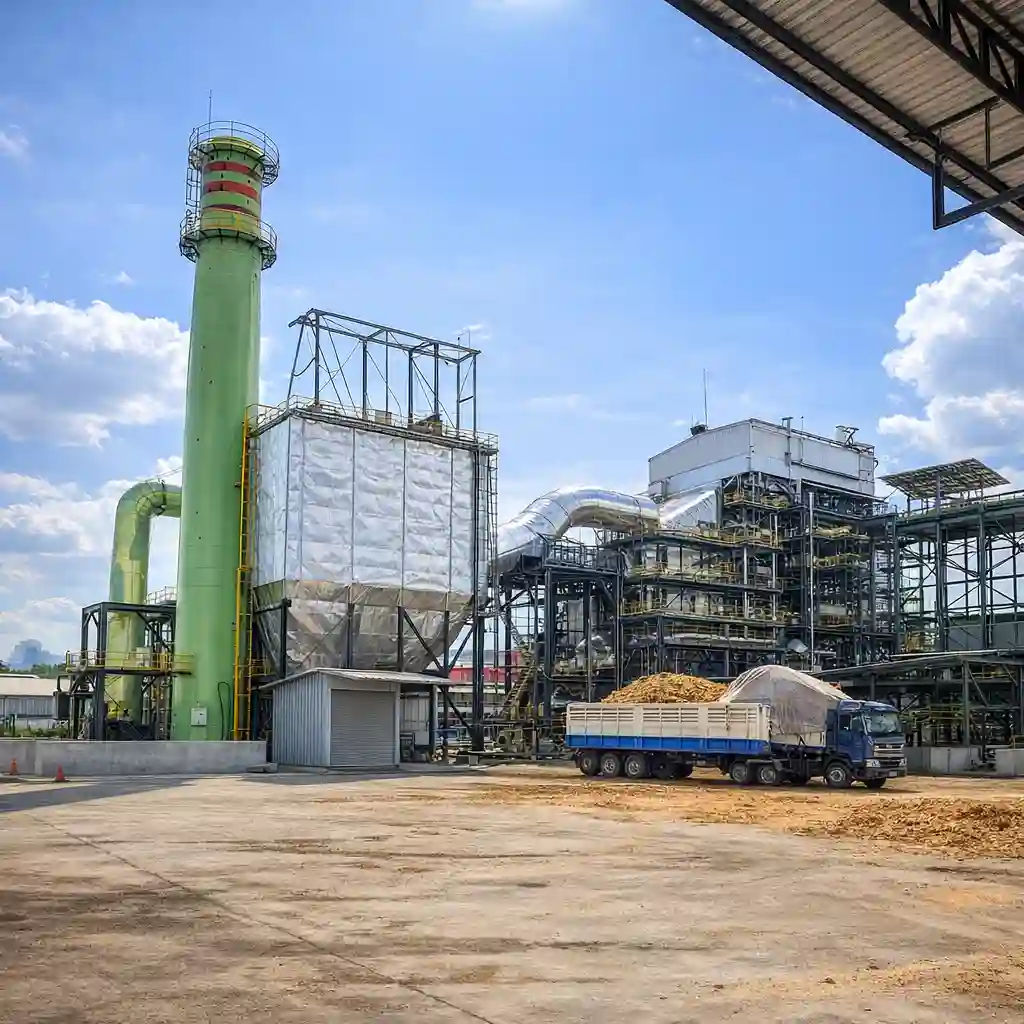
When a rice mill near Raipur swapped a 1980s coal-fired boiler for a 12 TPH biomass system engineered for rice husk, annual fuel costs fell by ₹59 lakh and stack emissions dropped below the Chhattisgarh PCB’s 100 mg/Nm³ particulate limit—on pace with India's latest CPCB guidelines. For factories seeking to simultaneously slash OPEX, decarbonize, and meet regulatory targets, the industrial question isn’t whether to deploy biomass steam generation, but how to maximize its technical and financial advantages.
Where Biomass Boilers Excel: Industry Use Cases with Operational Impact
Biomass boilers for industrial steam generation have moved far beyond theoretical promise: their most dramatic results are seen in energy-intensive sectors with abundant agro-waste or strict emission mandates.
Sugar Mills
- Challenge: Bagasse disposal and high steam requirements (24–45 bar, 400°C)
- Scenario: A 3500 TCD sugar mill in UP with an integrated cogeneration plant channels bagasse into a 45 TPH water-tube biomass boiler. This yields 19.2 MW exportable power and covers plant process steam, resulting in zero-fuel-cost operation during peak crushing.
Pharmaceutical Manufacturing
- Challenge: Stringent air quality compliance (CAQM, cGMP), high process steam purity
- Scenario: A pharma cluster in Gujarat adopted 8 TPH biomass boilers (multi-fuel, rice husk and sawdust), reducing boiler-room PM emissions to <85 mg/Nm³ and enabling full compliance with the 2024 CAQM particulate norms—while saving ₹42 lakh annually over imported coal.
Food Processing Industry
- Challenge: Volatile fuel oil prices, seasonal operation, food safety
- Scenario: A Maharashtra fruit canning facility retrofitted its 6 TPH furnace oil setup with a packaged biomass system, achieving 61% annual fuel cost reduction and streamlining CPCB emissions reporting.
Other strong adopters include paper mills (using black liquor/wood chips), distilleries (spent wash or biomass hybridization), and textile units keeping up with ZLD-related energy upgrades.
How Biomass Boilers for Industrial Steam Generation Work
At their core, biomass boilers combust renewable solid fuels—bagasse, rice husk, wood chips, paddy straw, coconut shell, and even agro-industrial wastes—to generate high-pressure steam for plant processes or cogeneration. Unlike fossil-fired units, they’re engineered for variable fuel inputs and high-ash operation without compromising on steam output or reliability.
Key Technology Features
- Capacity: 2–150 TPH (tons per hour) steam, typical industrial range 5–50 TPH
- Pressure/Temp: Up to 67 bar / 485°C for process-CHP, lower for saturated steam only
- Combustion System: Travelling grate, fluidized bed (AFBC, CFBC), or fixed grate, chosen based on fuel and ash content
- Fuel Flexibility: Designed for 1-8 distinct biomass types, with automated feeders and de-ashing
- Ancillaries: Multiclones, bag filters or ESPs for dust control, economizers for heat recovery, and auto blowdown for TDS management
Enercon Worldwide engineers these systems with fuel testing, layout integration, and control logic tuned to local compliance and uptime needs.
Energy Efficiency Insights: What Performance Gains Are Realistic?
Compared to legacy solid fuel boilers (uninsulated, no heat recovery, 72–78% efficiency), modern biomass-fired water-tube units routinely deliver 88–92% thermal efficiency, especially when fitted with economizers and air preheaters. For a 10 TPH boiler, even a 7% efficiency improvement can equate to ₹13–17 lakh annual fuel savings at current India rice husk prices (₹7–10/kg).
- Heat Recovery: Units with flue gas economizers see an additional 4–7% fuel reduction versus simple designs.
- Combustion Control: Modern oxygen trim and variable speed blowers offer 1–3% further savings by minimizing excess air and unburnt carbon.
- Condensate Recovery: Typical in pharma, textile, and food units—saves up to 18% on boiler make-up water and corresponding fuel input.
Enercon Worldwide customizes system sizing and firing control to achieve these targets on fuel- and ash-variable feedstocks, validated by pre- and post-installation steam/fuel audits.
Cost Optimization: ROI Scenarios and Payback Analysis
The strongest adoption driver for industrial biomass steam boilers remains operating cost reduction. Let’s examine a real-world India scenario:
Cost Benchmark Example
- Before: 8 TPH steam, FO-fired (furnace oil @ ₹75/litre, efficiency 80%), annual FO bill: ₹2.45 crore
- After: Biomass boiler, rice husk @ ₹9/kg, efficiency 88%, annual fuel bill: ₹99 lakh
- Annual Fuel Savings: ₹1.46 crore (60%)
- CAPEX: ₹1.15–1.4 crore (installed, incl. pollution control)
- Simple Payback: 10–15 months
In GCC markets (e.g., UAE, Saudi Arabia), where gas prices are higher but biomass is often imported, paybacks of 2.5–4 years are common for mid-size plants—still attractive due to carbon offset credits and energy security.
Variable OPEX reduction widens further when factoring in full-fuel-cycle savings: reduced fuel inventory, ash sales (especially in cement or brick allied sectors), and incentives under India’s PAT scheme for GHG abatement.
Biomass Boilers and Regulatory Compliance: Turning Mandates into ROI
Compliance is not just a risk—it's a catalyst for capital allocation. In India, CPCB/CAQM have tightened particulate and SO2 emission limits (100 mg/Nm³ for PM, 600 mg/Nm³ SO2 in most states), and the PAT scheme incentivizes verified fuel savings and CO2 reduction. Many state PCBs (Gujarat, Maharashtra, Punjab) have mandated fuel switching from fossil to non-fossil in key sectors.
- Example: Dyeing units in Surat, ordered to exit petcoke by 2024, have migrated to multi-fuel biomass boilers—attracting both regulatory goodwill and PAT scheme financial benefits.
- Penalty Reference: Non-compliant plants face fines from ₹2–5 lakh per closure notice, plus the risk of plant shutdown and loss of export eligibility due to failed ESG audits.
Enercon Worldwide project teams routinely include compliance mapping in feasibility studies, ensuring that boiler selection, stack height, and emission control match both Indian and GCC rules—minimizing risk and cost-of-delay.
Sustainability Impact: Emissions Reduction and Water Savings
Biomass-fired boilers directly offset fossil CO2: every tonne of rice husk combusted avoids approximately 1.53 tonnes of CO2 versus furnace oil. For a 10 TPH, 6000 hr/yr industrial plant, that’s 7900+ tonnes of annual CO2 savings—fully auditable for ESG and PAT scheme reporting.
- Water Savings: Condensate recovery can reduce makeup water demand by up to 8500 kilolitres/year, lowering STP/ETP loads and improving ZLD economics in textile and pharma plants.
- Fuel Circularity: Sectors like sugar and rice use their own byproducts, closing resource loops and enhancing their sustainability profiles—a significant advantage for export markets and BRSR/GRI compliance.
GCC nations increasingly link industrial incentives to GHG intensity targets; biomass boiler adoption supports both regulatory compliance and corporate sustainability mandates.
The Hidden Cost of Non-Compliance and Delayed Upgrades
Postponing boiler modernization or compliance upgrades can trigger cascading costs:
- Regulatory Fines: CPCB, CAQM, and state PCB enforcement has become more aggressive, with 2023 statistics showing over 400 industrial closure notices in Delhi NCR alone for air violations.
- Fuel Escalation: Reliance on furnace oil or petcoke exposes plants to price volatility; non-compliant fuel use can also mean no access to PAT credits or state incentives, eroding OPEX savings.
- Production Risk: Older boilers face breakdowns: a sugar plant in Maharashtra lost 18 shifts in 2022 due to ash choking and tube failure under variable coal, losses totalling ₹30 lakh in lost output and expedited repairs.
Timely transition to efficient, compliant biomass steam systems converts compliance deadlines from risk to ROI opportunity—a position Enercon Worldwide helps clients operationalize through project scheduling and technical roadmap planning.
Operational Challenges: Real Engineering Pain Points and Solutions
No boiler retrofit or greenfield build is challenge-free—especially for fuel-flexible biomass systems. The most common operating hurdles include:
- Fuel Variability: Ash, moisture, and calorific values of biomass can swing 10–20%; this is addressed via combustion control (O2 trim), advanced grates (CFBC for high-ash), and dual-fuel provisioning.
- Footprint Constraints: Existing plants may have only limited space for new boilers. Modular biomass packages and vertical layout redesigns (with remote-mounted ESPs) can condense the installation to <30 m² for systems up to 8–10 TPH.
- Downtime Risk: Changeover projects timed for annual overhauls; Enercon Worldwide’s commissioning teams often achieve swap-out/retrofit in <21 days for 6–12 TPH scales.
- Manpower and Training: Skilled operator demand is higher for AFBC/CFBC; Enercon supplies operational training, automation, and remote diagnostics as part of the commissioning package.
Addressing these challenges proactively is critical to realizing sustained fuel savings, safety, and regulatory compliance.
Technology Comparison: Biomass Boilers Versus Alternatives
Industrial buyers often weigh biomass steam generation against coal, oil/gas, or electric boilers. Key comparison points:
- Biomass vs Coal: Biomass systems have marginally lower achievable pressures (up to 67 bar typical) than coal, but slash CO2 by 80–85% and avoid petcoke bans and pollution surcharges. Modern CFBC designs reach 90–92% efficiency versus 80–84% for old coal units.
- Biomass vs Oil/Gas: Biomass capex is higher (30–50% above FO/NG) but paybacks are fast (<18 months) due to India’s differential in fuel cost per MMBTU (biomass ₹700–950, FO ₹1300+).
- Boiler Technology Types: Travelling grate best for coarse fuels with moderate ash; AFBC/CFBC preferred for fine, variable biomass mixtures (rice husk, paddy straw), supporting higher ash and load swings without clinker jamming.
A careful assessment of fuel logistics, emission rules, and process steam profiles—ideally conducted with an engineering partner such as Enercon Worldwide—will clarify the optimal technology fit.
Sector Deep Dive: Biomass Steam Generation Applications
Distilleries (Molasses and Grain-Based)
- Operational Challenge: Managing spent wash disposal and high steam-to-fuel ratio
- Solution: Cogeneration biomass boiler (30–60 TPH, AFBC) burning spent wash and bagasse mix
- Outcome: Waste volume reduced 75%, 14.5 MW power export, full PAT compliance, and annual fuel savings exceeding ₹2 crore for plants over 100 KLPD
Textile Processing
- Operational Challenge: Meeting ZLD and air emission mandates post-2023 amendments
- Solution: 8–10 TPH biomass water-tube boilers, rice husk/sawdust fired, paired with ESP and online emissions monitoring
- Outcome: 65% annual steam cost reduction, compliance with sub-100 mg/Nm³ PM, eligibility for state eco-incentives
Cement Allied Industry
- Operational Challenge: High fossil energy spend, need for biomaterial disposal
- Solution: Hybrid waste heat + biomass boilers (up to 18 TPH), firing RDF and agro-waste
- Outcome: 22–28% fossil substitution, 7800 T/yr CO2 abatement, better utilization of cement kiln dust
Such sector-driven configurations underscore why technology and project design must be tailored—not templated.
Future Trends in Biomass Steam Generation
Indian and GCC sectors are seeing next-gen trends that further enhance the value proposition of biomass boilers for industrial steam generation:
- Hydrogen Blending: Pilot projects are introducing up to 15% hydrogen-rich syngas co-firing to push efficiencies and slash residual CO2, especially where Green hydrogen is produced onsite.
- AI/IoT-Based Predictive Maintenance: Real-time ash and flue gas analytics catch clinker build-up and cyclone failure early, cutting downtime by 18–30% and reducing O&M costs.
- Modular/Containerized Installations: Deliver 6–12 TPH mobile biomass boilers for fast industrial expansion or EPC timelines, now popular in textile clusters and sugar “mini-scale” units.
- SCADA/Industry 4.0 Integration: Digital dashboards and remote alerts for emissions, fuel ratios, and maintenance windows are now a standard ask, especially in compliance-heavy sectors.
Enercon Worldwide incorporates these trends into project roadmaps, ensuring future-readiness and process transparency.
Decision-Making Guidance: Selecting the Right Biomass Boiler
Choosing the best biomass boiler for industrial steam generation involves structured evaluation—not just price or nameplate rating. Here's an actionable checklist for plant managers and EPC heads:
- Fuel Source Mapping: Can you ensure year-round biomass supply and logistics within 200 km radius? Fuel cost and consistency drive the payback model.
- Emission Compliance: Does the supplier guarantee sub-100 mg/Nm³ PM and state-specific SO2/NOx benchmarks?
- Boiler Type Fit: If high-ash, variable fuel: AFBC/CFBC preferred. For coarse, dry agro-waste: moving/travelling grate may suffice.
- CAPEX vs OPEX: Are installation, ancillary controls, and integration costs included in payback analysis? Insist on total cost mapping.
- After-Sales Support: What is the SLA for parts, training, and remote troubleshooting? Downtime can erase OPEX savings fast.
- Regulatory Ready: Has the design been mapped to likely 3–5 year tightening of emission norms (esp. CAQM, PCB updates)?
- Project Schedule: Typical design-to-commissioning window is 6–14 months—will this enable compliance (e.g., next PAT cycle deadlines)?
Engaging a design-and-build partner like Enercon Worldwide ensures that site audits, fuel/life-cycle studies, and regulatory mapping are built in from day one—streamlining technology selection and speeding ROI.
Acting Before the Next Compliance Cycle: Timing, Payback, and Next Steps
Biomass boiler projects for industrial steam generation require disciplined timelines—especially when aimed at aligning with the April 2026 PAT scheme or new CAQM notification deadlines in large metros. Given typical project timescales (8–14 months from order to steam), plants seeking to secure maximum ROI and avoid regulatory fines should:
- Undertake a facility energy and fuel audit within the next quarter
- Model detailed CAPEX and OPEX scenarios, validated by recent fuel market shifts
- Align project start to plant annual outages or off-season window
- Consult experienced engineering teams (such as Enercon Worldwide) for vendor-neutral, sector-specific solution mapping—including emission, water, and fuel integration modeling
Delaying modernization risks missing regulatory cycles and losing both incentive income and cost savings—while early action locks in both compliance and rapid payback. Plant owners ready to advance can start with a focused energy audit or feasibility study engineered to their sector, fuel zone, and compliance profile—moving beyond talk to actual, bankable OPEX reduction.
Related Enercon solutions
Planning an energy or utility project? Talk to the engineers at Enercon Worldwide or request a consultation. You can also browse all our business areas.